
In the heart of the European Alps, a landmark infrastructure project is rewriting the rules of modern tunneling. The Transalpine Rail Link, designed to slash travel times between two major cities by routing high-speed trains through a 22-kilometer base tunnel, recently achieved a major breakthrough—literally and figuratively—with the deployment of SupAnchor’s advanced self drilling anchor system. As tunneling crews battled squeezing ground, water inflows, and fractured rock masses, the company’s hollow bar anchors delivered unmatched speed, safety, and ground stabilization, proving once again that innovation in geotechnical reinforcement is essential for the world’s most demanding underground works.
The project, located at an altitude of 1,800 meters, faced a geological nightmare: a mix of tectonically sheared phyllites, graphitic schists, and water-bearing fault zones. Traditional drilling and anchoring methods faltered when boreholes collapsed before casing could be installed. It was here that the self drilling anchor bolt came into its own. By combining drilling, grouting, and anchoring into a single pass, SupAnchor’s drill-and-grout bolt eliminated the need for temporary casing, dramatically reducing installation time while providing immediate geotechnical reinforcement system support. The result was a 40% reduction in cycle times compared to conventional methods, according to on-site engineers.
The Transalpine Rail Link is one of Europe’s flagship TEN-T (Trans-European Transport Network) projects, with a total investment exceeding €8 billion. The base tunnel alone traverses some of the most unpredictable rock formations on the continent. During excavation, face collapses and radial deformations of up to 30 cm threatened to delay the schedule by months. The contractor needed a ground stabilization anchor system that could be installed rapidly and would perform reliably in wet, squeezing conditions. After extensive testing, they turned to SupAnchor’s SDA® series, a factory-direct ground anchor bolt factory product engineered for exactly these scenarios.
The key advantage lay in the hollow bar design. Each hollow bar anchor serves as both a drill rod and a permanent structural element. High-pressure flushing through the hollow core clears drill cuttings efficiently, while simultaneous grout injection fills the annular space and penetrates surrounding fissures, creating a robust bond with the ground. This dual-functionality makes the system ideal for tunneling, slope stabilization, and even as a micropile hollow bar anchor in foundation engineering. On this project, SupAnchor provided over 12,000 linear meters of SDA-R32 and SDA-38 anchors, with lengths ranging from 3 to 12 meters and working capacities up to 280 kN.
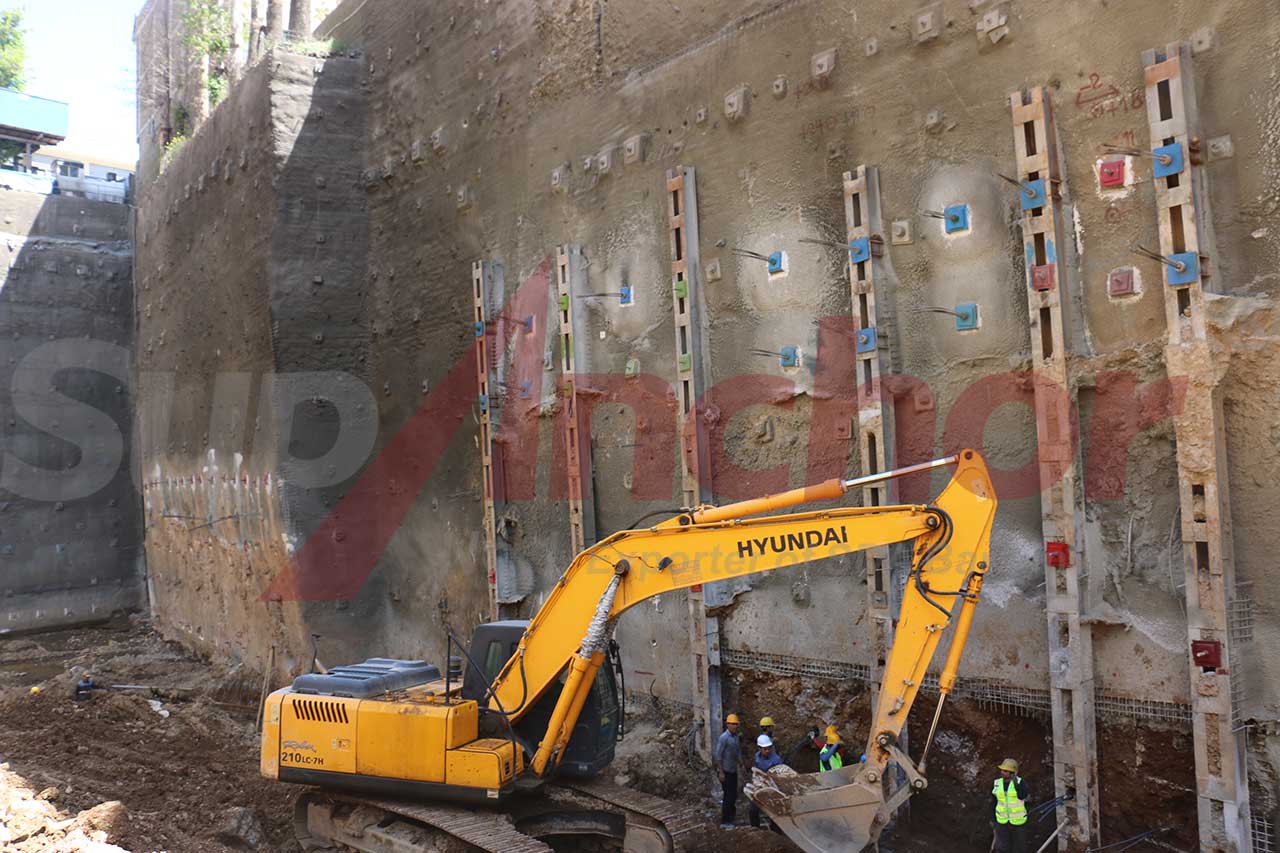
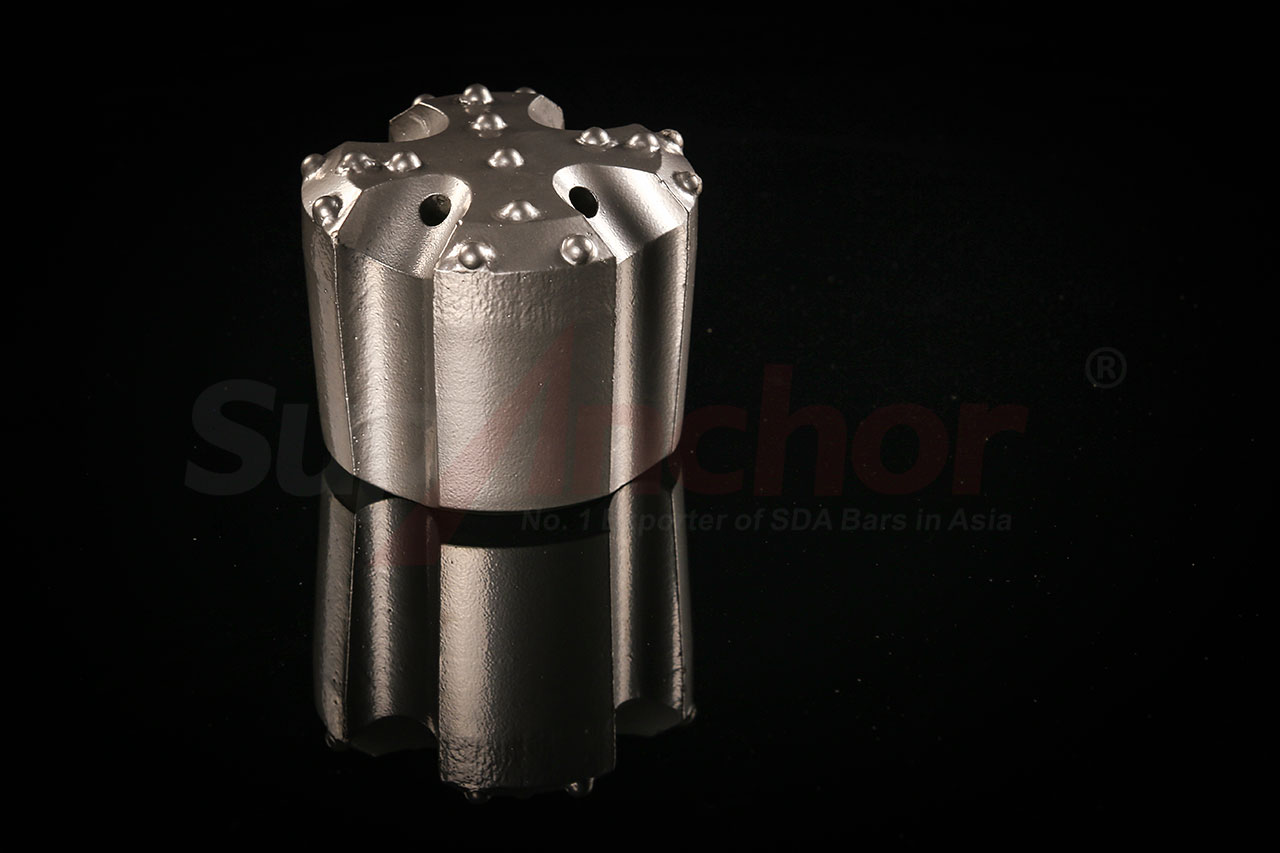
The accompanying construction site image captures a typical face stabilization sequence inside the tunnel. Miners are seen installing a pattern of self-drilling anchors after a blast round. The anchors are being drilled with hydraulic rotary-percussive drifters, using a specially designed sacrificial drill bit that remains in the hole. Once the target depth is reached, grouting commences directly through the hollow bar, with cementitious grout of water/cement ratio 0.4–0.5 pumped at pressures up to 1.5 MPa. The result is a fully grouted tendon that can be tensioned immediately if required, or left passive for early ground support. This process exemplifies the drill-and-grout bolt concept, which has revolutionized tunneling methodology worldwide.
To appreciate how SupAnchor’s system overcame the local geology, consider the technical parameters of the anchors deployed:
| Parameter | SDA-R32 | SDA-38 |
|---|---|---|
| Nominal Outer Diameter (mm) | 32 | 38 |
| Inner Hole Diameter (mm) | 16 | 19 |
| Cross-Sectional Area (mm²) | 400 | 660 |
| Ultimate Tensile Load (kN) | 230 | 420 |
| Working Load (kN) | 160 | 280 |
| Standard Length (m) | 2 / 3 / 4 / 6 | 2 / 3 / 4 / 6 / 8 |
| Coupler Type | Sleeve, torque-controlled | Sleeve, torque-controlled |
| Corrosion Protection | Hot-dip galvanized (≥85 µm) or epoxy coated | Hot-dip galvanized (≥85 µm) or epoxy coated |
| Drill Bit | Cross-type or button, carbide-tipped | Cross-type or button, carbide-tipped |
| Thread | R32 rope thread, LH | T38 rope thread, LH |
The selection of R32 and 38 mm diameters was driven by the need for rapid installation in limited drill-jumbo feed lengths, combined with sufficient structural capacity to control radial displacements. In the fault zones, longer anchors (up to 12 m) were coupled from 3- or 4-meter sections using SupAnchor’s precision-manufactured sleeve couplers, ensuring full strength at the joint. The hot-dip galvanized coating provided long-term durability against aggressive alpine water, a critical factor for the tunnel’s 100-year design life. For areas with higher chemical aggressiveness, epoxy-coated tendons were available, demonstrating the system’s versatility as an anchor bolt system for geotechnical engineering.
On-site, the self-drilling units were installed using a two-boom electro-hydraulic drilling jumbo. Each anchor took approximately 3–5 minutes to drill and grout, compared to 15–20 minutes with casing-based systems. This efficiency translated into faster advance rates and earlier ring closure, significantly reducing the risk of uncontrolled deformations. The immediate coupling of drilling and grouting also minimized overbreak, a common problem in heterogeneous rock. SupAnchor’s SDA bolt factory direct supply model ensured just-in-time delivery of customized lengths and accessories to the remote jobsite, avoiding costly delays.
The success of the Transalpine Rail Link reflects a broader global shift toward mechanized excavation and integrated support solutions. With urbanization and transportation networks expanding into challenging terrains, the demand for reliable ground stabilization anchor system s is soaring. Self-drilling anchors are now standard in sectors ranging from highway widening and retaining walls to underground mining and hydropower caverns. As a soil nail system manufacturer, SupAnchor has been at the forefront of this evolution, continuously refining its hollow bar technology to meet stringent international standards such as EN 14490 and ASTM A615.
In urban environments, self drilling anchor for retaining walls applications are growing rapidly. Deep excavations next to sensitive structures require minimal vibration and zero casing removal, making hollow bar anchors the preferred choice. They can be installed at any angle, through overburden and weathered rock, and grouted to form a contiguous reinforced zone. For temporary works, removable versions are also available. Similarly, in the mining sector, rock bolt for underground mining systems based on self-drilling principles have gained traction due to their adaptability to inconsistent rock horizons and ability to provide both suspension and beam-building reinforcement.
The micropile market is another key growth area. SupAnchor’s micropile hollow bar anchor solutions are increasingly specified for underpinning historic buildings, bridge seismic retrofits, and foundation reinforcement in karstic ground. By using the same bar as a pile and grout injection tube, contractors can install load-bearing elements of up to 500 kN working capacity in confined spaces with minimal equipment. This aligns perfectly with the industry’s drive toward low-impact, sustainable construction methods.
“We’re seeing a convergence of needs,” explains a senior geotechnical engineer involved in the alpine project. “Whether it’s high-speed rail, metro expansion, or renewable energy infrastructure, the requirement is for faster, safer, and more adaptable ground engineering. The self drilling bolt for civil engineering ticks all those boxes. SupAnchor’s quality consistency and technical support have been essential in pushing the limits of what’s achievable.”
Behind every successful project lies a manufacturer committed to quality and innovation. SupAnchor, with over 15 years of specialization in self-drilling anchor systems, has earned a reputation as a ground anchor bolt factory that delivers not just products, but engineered solutions. The company’s ISO 9001:2015 and ISO 14001:2015 certifications underpin a rigorous quality management system that spans raw material sourcing, CNC machining, heat treatment, and corrosion protection. Each batch of hollow bars undergoes tensile testing, dimensional checks, and coating thickness measurement before shipment.
SupAnchor’s SDA® line exemplifies the “Professional, Innovative, Collaborative” ethos. Professionalism is evident in the detailed design support provided to consultants and contractors, including pull-out test simulations, corrosion life assessments, and installation method statements. Innovation shines through patented thread designs that optimize load transfer and reduce grout blockages, as well as the development of eco-friendly, biodegradable flushing additives for environmentally sensitive sites. Collaboration is at the core of every project, with SupAnchor engineers regularly stationed on-site to troubleshoot and train crews.
The company’s global footprint now extends to over 30 countries, with reference projects ranging from the Sydney Metro tunnels in Australia to the Olmos Trans-Andean hydraulic tunnels in Peru. In each case, the combination of high-strength steel, precise manufacturing, and application expertise has been decisive. A recent expansion of the factory’s heat-treatment line doubled capacity for high-tensile (up to 850 MPa UT) anchor bars, meeting the growing demand for ultra-high-performance geotechnical reinforcement system components.
Looking ahead, SupAnchor is investing in digitalization—embedding RFID tags in anchor bars for traceability and developing a cloud-based monitoring platform that records installation parameters in real time. This data-driven approach not only enhances quality assurance but also provides invaluable feedback for ground model calibration. In the words of the CEO, “We’re not just selling steel; we’re providing certainty in uncertain ground. Our mission is to make underground construction safer and more predictable for everyone involved.”
As the Transalpine Rail Link progresses toward its 2028 opening, the contribution of SupAnchor’s self-drilling anchor technology will be embedded in every meter of safe, stable tunnel. It stands as a testament to the power of innovative geotechnical solutions in shaping the infrastructure of tomorrow.
A major Alpine tunneling project employs SupAnchor's self-drilling anchor system to overcome complex geology, ensuring safety and efficiency in ground stabilization.
SupAnchor’s new Grade 75 self-drilling hollow anchor bars offer superior bond performance and cost-efficiency for slope stabilization, tunneling, and foundation reinforcement. Discover technical specs and industry impact.
SupAnchor’s self-drilling anchor system proved vital in stabilizing a highway tunnel through fractured rock, showcasing advanced geotechnical reinforcement technology for safety and efficiency.
SupAnchor launches the SupFRP® GFRP Friction Bolt, a patented innovation offering high corrosion resistance, lightweight design, and enhanced safety for mining and tunneling projects worldwide.
SupAnchor’s self drilling anchor system provides critical ground stabilization for a major European tunnel project, demonstrating advanced geotechnical reinforcement technology.