
In an era where infrastructure resilience is paramount, the construction industry grapples with the costly challenge of corrosion. Traditional steel reinforcement, while strong, degrades when exposed to chlorides, moisture, and aggressive soils—leading to premature structural failure and escalating maintenance budgets. Recognizing this critical need, SupAnchor, a premier manufacturer of geotechnical reinforcement systems, has launched the SupFRP® GFRP Reinforcement Rebar. This innovative product harnesses the corrosion immunity of fiberglass composites to offer a durable, high-strength alternative for concrete reinforcement.
SupAnchor has long been synonymous with reliability in demanding ground conditions, supplying self drilling anchor systems and hollow bar anchors for tunneling, mining, and slope stabilization. The introduction of GFRP rebar expands the company's reinforcement portfolio, leveraging decades of material engineering to address the shortcomings of steel in concrete structures. From marine environments to industrial plants, the new rebar sets a new standard for longevity and performance.
The SupFRP® rebar is crafted from high-quality E-CR glass fibers embedded in a premium vinyl ester resin matrix. This composition delivers exceptional resistance to alkalis, acids, and salts—chemicals that would rapidly degrade steel. The outer surface features a waved thread structure, mechanically bonded to the core, which provides a robust interlock with concrete. This design ensures load transfer efficiency comparable to ribbed steel rebar, while eliminating the risk of crevice corrosion at the interface.
Key technical specifications of the SupFRP® series are summarized below. Across the range, the rebar maintains an elastic modulus of 50 GPa and an ultimate strain of 2%, ensuring predictable, ductile-like behavior under load.
| Model | Outside Diameter (mm) | Guaranteed Tensile Load (kN) | Tensile Strength (MPa) | Weight (kg/m) |
|---|---|---|---|---|
| ReB-12 | 14 | 113 | 1000 | 0.28 |
| ReB-16 | 18 | 201 | 1000 | 0.50 |
| ReB-20 | 23 | 314 | 1000 | 0.79 |
| ReB-25 | 28 | 491 | 1000 | 1.20 |
| ReB-30 | 34 | 636 | 900 | 1.88 |
| ReB-40 | 45 | 1006 | 800 | 3.10 |
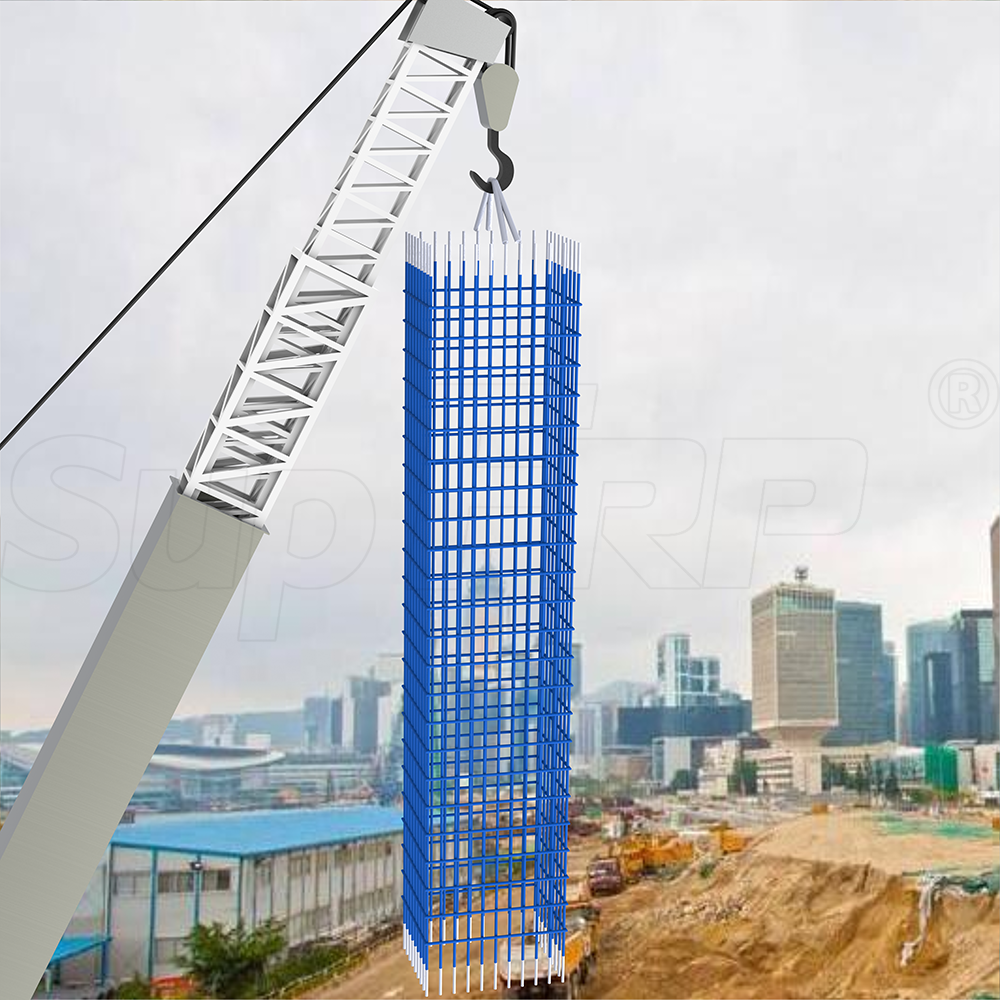
With tensile strengths ranging from 800 to 1000 MPa, the SupFRP® rebar matches or exceeds the yield strength of conventional steel reinforcement, but at a fraction of the weight. A 25 mm diameter GFRP rebar weighs only 1.20 kg/m, compared to over 3.85 kg/m for an equivalent steel bar. This lightweight nature cuts transportation emissions and simplifies placement, reducing crane lifting requirements and worker fatigue. Additionally, the rebar is easily cut with carbide-tipped saws or angle grinders, without the need for specialized heavy equipment.
The non-conductive and non-magnetic characteristics open up applications unattainable with steel. In railway electrification projects, GFRP rebar eliminates the risk of stray current corrosion and magnetic interference with signaling systems. Similarly, in medical facilities housing MRI equipment, the rebar ensures structural reinforcement without distorting imaging fields. These unique properties make SupFRP® a strategic choice for smart infrastructure and sensitive installations.
The versatility of SupFRP® GFRP rebar is demonstrated across a spectrum of challenging construction scenarios:
One notable deployment of SupFRP® rebar is in a major coastal highway expansion project in Southeast Asia. The project's design team initially specified epoxy-coated steel for the 12 km bridge segment, but the harsh marine environment and high humidity raised concerns about long-term durability. After thorough evaluation, they switched to SupFRP® ReB-25 and ReB-30 for the deck slabs and edge beams. The rebar's consistent tensile strength and ease of installation helped the contractor stay on schedule, and monitoring over the first year confirmed zero corrosion activity. This success underscores the rebar's readiness for the most demanding infrastructure projects.
While the initial purchase cost of GFRP rebar may be higher than traditional steel, a lifecycle cost analysis reveals compelling economic advantages. Reduced maintenance interventions, extended structural life, and elimination of corrosion protection systems yield savings that often exceed the upfront premium. For publicly funded infrastructure, these benefits translate into more predictable budgets and lower long-term taxpayer burdens.
Moreover, the light weight of GFRP rebar contributes to sustainability by reducing fuel consumption during transportation. The material's inert nature also means no toxic leachates, and at the end of its life, the rebar can be recycled or repurposed into energy-intensive processes without heavy metal contamination. As global construction moves toward green building certifications such as LEED and BREEAM, the SupFRP® rebar aligns with credits for material innovation and lifecycle performance.
SupAnchor operates state-of-the-art manufacturing facilities, certified to ISO 9001 and ISO 14001 standards. Every production batch of SupFRP® rebar undergoes rigorous quality control testing, including tensile strength verification and alkali resistance aging tests, ensuring compliance with ACI 440 and other international guidelines. The company's dedicated R&D team continuously refines the fiber-resin formulation to enhance durability, bond strength, and temperature resistance.
With a distribution network spanning over 50 countries, SupAnchor provides timely technical support and product availability. From soil nail systems to ground anchor bolts and now GFRP rebar, the company's integrated approach helps engineers and contractors solve complex reinforcement challenges. As infrastructure investment surges worldwide—fueled by urbanization, climate resilience, and renewable energy—the demand for reliable, corrosion-free reinforcement solutions is set to grow exponentially.
For more information about SupFRP® GFRP Reinforcement Rebar, including technical datasheets and custom shape options, visit www.supanchor.com or contact the engineering team directly. SupAnchor remains committed to professional, innovative, and collaborative partnerships that build a stronger, more sustainable future.
A major Alpine tunneling project employs SupAnchor's self-drilling anchor system to overcome complex geology, ensuring safety and efficiency in ground stabilization.
SupAnchor’s new Grade 75 self-drilling hollow anchor bars offer superior bond performance and cost-efficiency for slope stabilization, tunneling, and foundation reinforcement. Discover technical specs and industry impact.
SupAnchor’s self-drilling anchor system proved vital in stabilizing a highway tunnel through fractured rock, showcasing advanced geotechnical reinforcement technology for safety and efficiency.
SupAnchor launches the SupFRP® GFRP Friction Bolt, a patented innovation offering high corrosion resistance, lightweight design, and enhanced safety for mining and tunneling projects worldwide.
SupAnchor’s self drilling anchor system provides critical ground stabilization for a major European tunnel project, demonstrating advanced geotechnical reinforcement technology.