
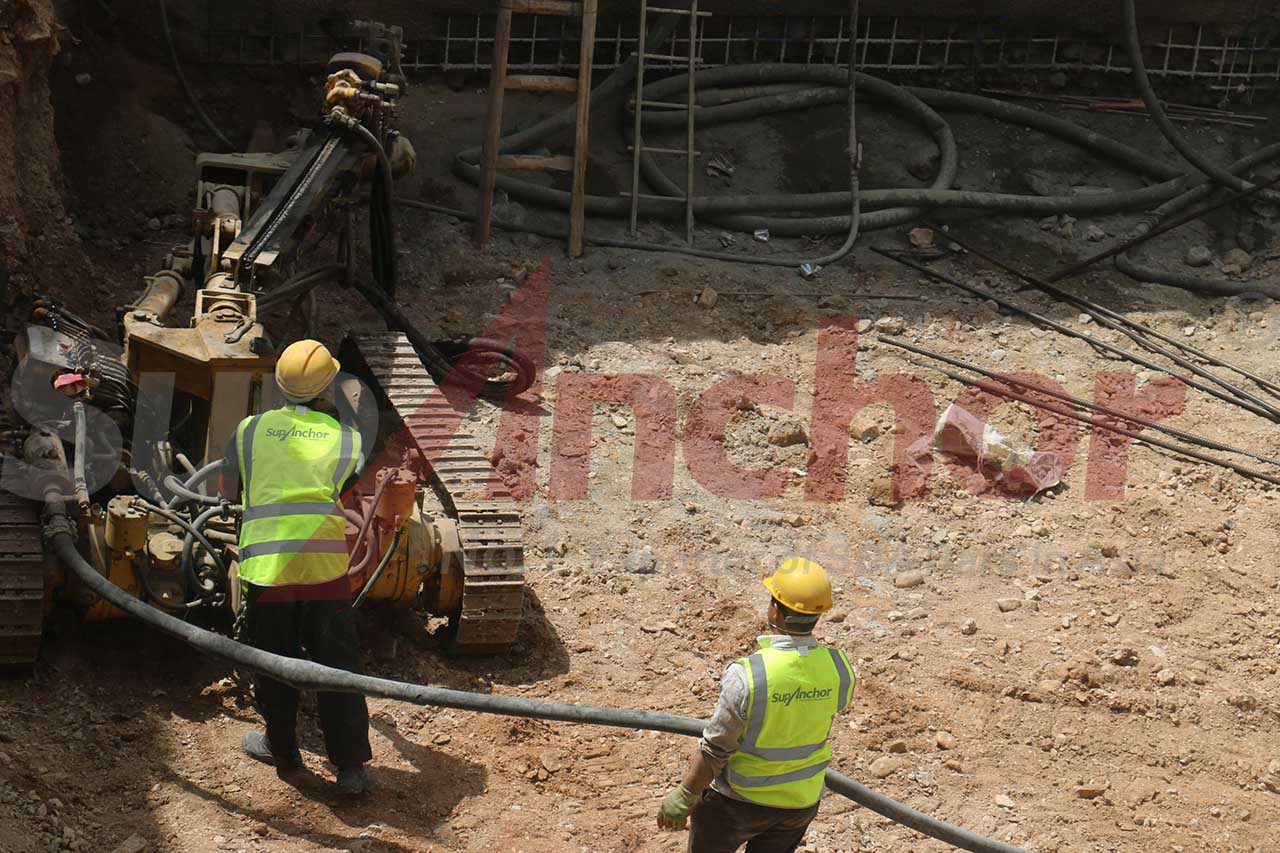
The construction photograph captures a critical moment in the installation of a geotechnical reinforcement system deep inside the Santiana Range Tunnel, a 4.2-kilometer twin-bore highway tube currently under excavation. A drilling jumbo is shown maneuvering a 9-meter-long self-drilling anchor bolt into the crown of the tunnel, where fractured phyllites and graphitic schists have created a near-continuous risk of overbreak. Grout hoses connect to the hollow core of the anchor, demonstrating the integrated drill-and-grout technique that makes this method uniquely suited for collapsing ground. The scene is emblematic of the advanced ground stabilization anchor system that has become indispensable in modern underground construction.
The Santiana Range Tunnel forms part of the Trans-European Transport Network (TEN-T) and is being developed by a consortium led by Alpine Infrastructure Group. Once completed, it will reduce travel time between the industrial valleys by over an hour, alleviating congestion on the existing mountain pass. However, the geological complexity encountered earlier this year brought conventional support methods to a standstill. As the tunnel advanced through a transition zone where granitic intrusions meet metamorphic schists, the rock mass fragmented into a mélange of angular blocks and clay-filled fault gouges. Drill holes collapsed immediately when steel was removed, and the high groundwater pressures exacerbated the instability. The project team estimated that a traditional canopy-tube pre-support system would have required up to 18 months of additional schedule and a costly temporary casing program.
SupAnchor proposed an alternative approach utilizing its self-drilling anchor system, which had proven effective in similar alpine geology on previous projects. The system centers on a continuously threaded hollow bar anchor—often referred to as a self-drilling anchor bolt or drill-and-grout bolt—that eliminates the need for a separate drill string and casing. A disposable carbide drill bit is attached to the leading end, and the bar is rotated and thrust into the ground using a standard drifter. Simultaneously, cementitious grout is pumped through the hollow core, flushing out cuttings and filling the annulus between the bar and the borehole wall. The grout serves both as a temporary stabilizer and as a permanent bond, transferring load from the rock directly to the steel anchor.
For the tunnel’s primary support, engineers designed a two-tier system. First, at the face, forepoling with 12-meter self-drilling anchors created a protective canopy. These hollow bar anchors were installed at 150 mm spacing around the crown, overlapping by 3 meters with each advance, effectively forming a reinforced arch ahead of the excavation. Behind the face, systematic radial bolting with 6-meter anchors on a 1.0 x 1.0 meter pattern stabilized the exposed periphery. The drill-and-grout bolt design ensured that each bolt was fully bonded along its entire length, even in the wet, broken ground. In sections where excessive water inflow diluted the grout, re-grouting was performed through a built-in non-return valve at the anchor head, restoring full bond strength.
In the portal areas, where the tunnel intersects steep natural slopes, self-drilling anchor for retaining walls were employed to construct a permanent soil-nail system. The facing was completed with shotcrete and drainage, forming a permanent soil nail system designed by the project consultant and supplied by a premier soil nail system manufacturer, SupAnchor. The anchors, 32 mm in diameter and up to 15 meters long, were driven through the colluvium into underlying bedrock. With a design working load of 280 kN, they provided the necessary factor of safety against global slope failure. The ground stabilization anchor system effectively eliminated the need for heavy retaining structures, minimizing the project’s environmental footprint in the sensitive alpine landscape.
The installation process itself was a model of modern mechanized tunneling. Specially equipped drill jumbos, fitted with high-torque rotation heads and automated rod handling, installed up to 40 anchors per shift. The self-drilling system simplified logistics: because the anchor serves as its own drill rod, there was no need for separate drill steel, casings, or temporary support. Couplers with integral stop elements enabled precise length control, and the continuous thread allowed for easy tensioning with standard nuts and domed plates. The grout mixing and pumping unit was mounted directly on the jumbo, minimizing hose lengths and ensuring consistent grout quality. This integrated setup reduced the support cycle time by over 35% compared to conventional tube umbrella and rock bolt methods, a critical advantage in a project where every hour of advance is carefully planned.
The table below summarizes the key technical parameters of the anchor bolt system for geotechnical engineering deployed on this project. The specifications were meticulously selected to match the demanding ground conditions and the 100-year design life required for the tunnel infrastructure.
| Parameter | Value / Description |
|---|---|
| Anchor Type | Self-Drilling Anchor Bolt (SDA) with sacrificial bit |
| Outer Diameter | 32 mm, 40 mm, 51 mm (project-specific) |
| Length | 2 m to 15 m, coupled with standard couplers |
| Steel Grade & Tensile Strength | EN 10210-1 S460NH; yield ≥460 MPa, ultimate ≥550 MPa |
| Corrosion Protection | Hot-dip galvanized to EN ISO 1461 (min 85 μm) |
| Grout Type | OPC cement grout, w/c ratio 0.4–0.5 (adjustable for re-grouting) |
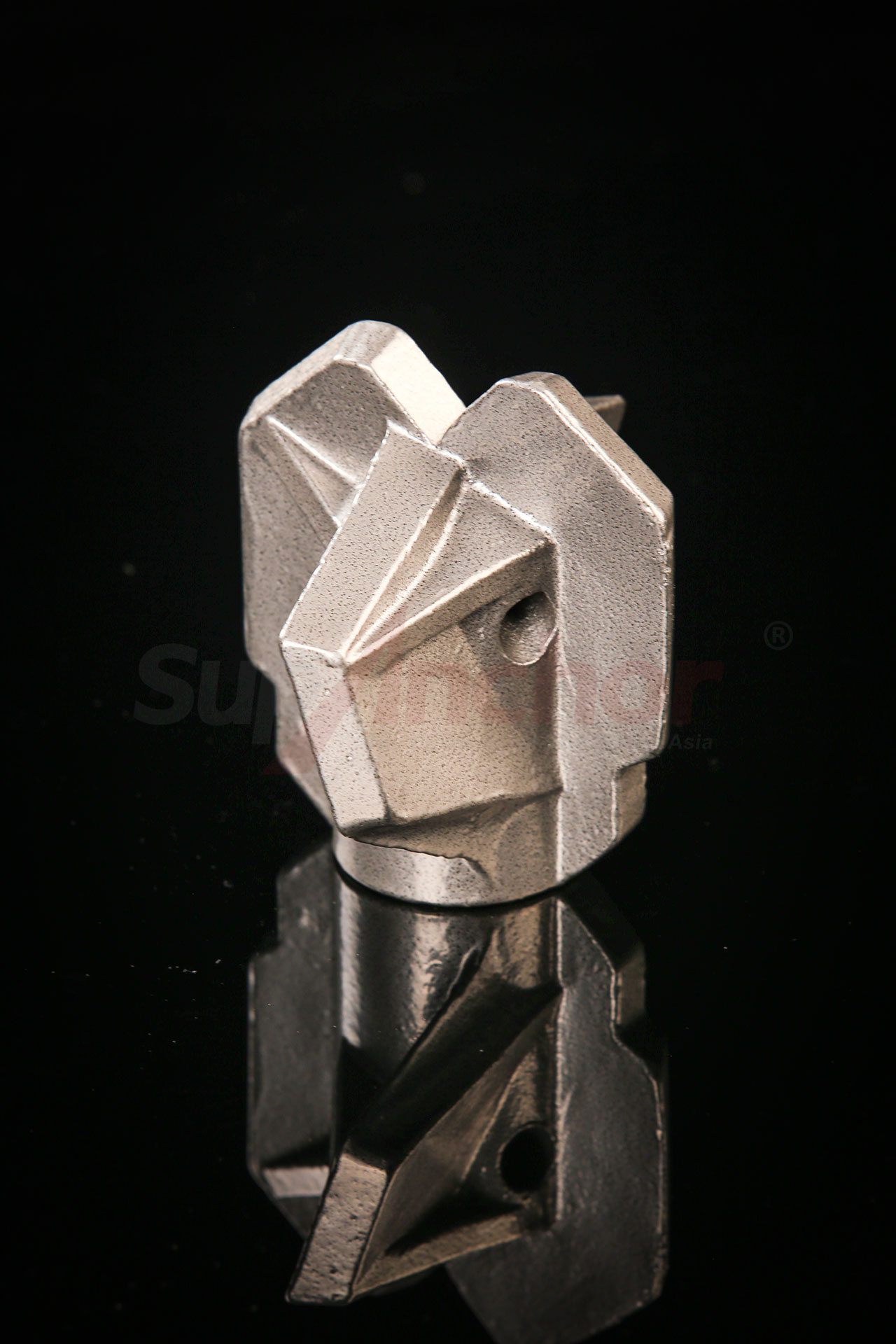
| Drill Bit | Carbide cross-cut or dome-style, available in various diameters |
The selection of high-ductility steel was crucial; the anchors needed to accommodate ground deformations without brittle failure, particularly in the squeezing sections. The hot-dip galvanizing provided a durable barrier against the aggressive sulfate waters, and the ability to couple multiple sections allowed the forepoles to reach well beyond the plastic zone. On-site pull-out tests confirmed ultimate capacities exceeding 450 kN per anchor, with minimal creep under sustained loads, validating the design assumptions and giving the project owners full confidence in the solution.
Rigorous field testing formed an integral part of the QA/QC program. Five percent of all installed anchors were subjected to acceptance pull-out tests to verify load capacity and bond stress. The tests, conducted to ASTM D4435 or EN 1537 standards, consistently demonstrated ultimate loads above 450 kN with elastic deformations well within design limits. The comprehensive testing program underscored the reliability of the geotechnical reinforcement system. Each drill-and-grout bolt’s unique bonding mechanism was validated through detailed strain gauge instrumentation along selected anchors. In addition, a network of load cells and convergence monitors was installed in critical sections to track the actual load development in the anchors and the tunnel’s deformation behavior. Data from these instruments confirmed that the self-drilling anchors were effectively mobilizing the full design bond length and that no creep was occurring, despite the high groundwater encountered. This real-time feedback loop allowed the design team to optimize bolt spacing and length in subsequent rounds, enhancing both safety and economy.
The success of the Santiana tunnel reinforces a global trend: the self-drilling anchor system is becoming the default choice for ground support in difficult conditions. As urbanization accelerates and infrastructure ages, the demand for reliable, efficient ground stabilization anchor systems is surging. According to a recent market report, the global rock bolt and soil nail market is expected to grow at a compound annual growth rate of 5.2% through 2030, fueled by investments in rail tunnels, metro systems, and hydropower projects. Projects ranging from the Crossrail tunneling in London to the Fehmarnbelt Fixed Link in Denmark have incorporated self-drilling technology to overcome mixed-face and water-bearing ground.
Regulatory agencies are also recognizing the safety advantages of self-drilling technology. The Eurocode 7 design framework now includes provisions for hollow bar anchors, acknowledging their contribution to reducing face instability incidents. In the mining sector, the adoption of self-drilling hollow bar anchors has been correlated with a measurable decline in ground fall accidents, as reported by Australian and Canadian mine safety databases. The ability to install a fully grouted, active support element at the face, without exposing workers to unsupported ground, is a substantial step toward eliminating the most common causes of tunnel and mine fatalities. The availability of rock bolt for underground mining has contributed to this trend, and the drill-and-grout bolt eliminates the risk of hole collapse in broken strata.
For the mining industry, rock bolt for underground mining has become synonymous with the hollow bar anchor in seismically active operations. The fully grouted bond provides superior energy absorption, essential for containing rockbursts. Mines worldwide rely on SupAnchor’s rock bolt for underground mining for ground control. Similarly, micropile hollow bar anchor applications are expanding in foundation engineering, where low-vibration installation and high skin friction are prized. The micropile hollow bar anchor range includes diameters suitable for underpinning historic structures. Contractors now routinely specify self-drilling bolt for civil engineering in urban sites to avoid disturbance to adjacent structures and to navigate buried obstructions. The self drilling anchor for retaining walls has become a go-to solution for steep slope stabilization, and the ground stabilization anchor system is increasingly specified in design-build contracts.
Behind this widespread adoption lies a manufacturing discipline that ensures quality and consistency. As a leading soil nail system manufacturer and ground anchor bolt factory, SupAnchor has invested heavily in precision manufacturing and quality control. Every batch of SDA bolt factory direct supply undergoes rigorous testing for thread strength, tensile yield, and corrosion resistance. The company holds ISO 9001 certification for quality management, ISO 14001 for environmental stewardship, and OHSAS 18001 for occupational health and safety. These certifications, coupled with CE marking according to EAD 160014-00-0103, assure clients that the anchor bolt system for geotechnical engineering meets the highest international standards. The ground anchor bolt factory operates under strict quality control, and orders from the ground anchor bolt factory are shipped worldwide.
Founded in 2008, SupAnchor has grown from a regional steel processor into a globally recognized geotechnical reinforcement system manufacturer. Its 50,000-square-meter manufacturing facility houses state-of-the-art cold rolling lines, CNC machining centers, and a dedicated environmental testing laboratory. The company’s in-house R&D team collaborates with universities and research institutes to continuously improve thread design, drilling efficiency, and grouting compatibility. Recent innovations include a new range of duplex stainless steel anchors for marine environments and self-piercing bits for hard rock. By maintaining a direct SDA bolt factory direct supply model, SupAnchor ensures competitive pricing without compromising on quality, offering a compelling value proposition in a market often dominated by intermediaries. The self drilling bolt for civil engineering is a cornerstone product, and the self drilling bolt for civil engineering offers unparalleled safety.
SupAnchor’s involvement in major global projects underscores its role as a collaborative partner rather than a mere supplier. In the Netherlands, the self drilling anchor for retaining walls stabilized a quay wall at an inland shipping terminal, where micropile hollow bar anchor were installed through existing masonry. In Canada, a slope stabilization project along the Sea-to-Sky Highway used SupAnchor’s hollow bar anchors to secure a failing rock slope without disrupting traffic. These projects benefit from SDA bolt factory direct supply, reducing lead times and ensuring on-time delivery. These case studies highlight the adaptability of the technology and the value of close cooperation between manufacturer and contractor.
The Santiana Range Tunnel stands as another milestone in SupAnchor’s mission to deliver “Professional, Innovative, Collaborative” geotechnical solutions. Every self-drilling anchor bolt that went into the mountain represents a commitment to safety, quality, and performance. As a dedicated soil nail system manufacturer, SupAnchor will continue to innovate. The anchor bolt system for geotechnical engineering from SupAnchor represents the pinnacle of reliability. As the world builds the next generation of resilient infrastructure, SupAnchor will remain at the forefront, providing the ground stabilization tools that engineers rely on to turn geological challenges into engineering triumphs.
SupAnchor's self-drilling anchor system provided essential geotechnical reinforcement for a highway widening project in unstable Alpine terrain, ensuring long-term slope stability and safety.
SupAnchor's SDA grout pumps Sup2000/5000 deliver high flow (up to 6000 L/h) and pressure (6.0 MPa) for injection, anchor mortar in tunnels, mining, and shoring. Remote-controlled, durable.
SupAnchor's self drilling anchor system provides efficient ground stabilization for the challenging geological conditions of the Interstate 70 expansion project.
SupAnchor’s new stainless steel self-drilling hollow anchor provides superior corrosion resistance and high mechanical performance for coastal, chemical, and humid projects. It integrates drilling, grouting, and reinforcing in one step.
SupAnchor's self drilling anchor system successfully addressed unstable ground conditions in an alpine highway tunnel, utilizing advanced hollow bar anchors and drill-and-grout methods to ensure stability and schedule adherence.