
On a steep, geologically complex hillside where conventional drilling and casing methods had struggled, contractors turned to SupAnchor's self drilling anchor system to complete foundation support and slope stabilization works on schedule. The project, part of a wider transportation corridor upgrade in a mountainous region, required more than 40,000 linear meters of permanent and temporary anchoring across four distinct work faces. Engineers faced fractured rock, variable overburden, high groundwater ingress, and access restrictions that ruled out large conventional piling rigs.
The decision to deploy a self drilling anchor bolt solution came after initial trial installations with cased boreholes showed unacceptable time loss and hole collapse. The SupAnchor system, which combines drilling, anchoring, and grouting in a single pass, eliminated the need for temporary casing and reduced the risk of borehole instability. This article examines the project background, the technical parameters of the anchor system, and the broader industry implications for geotechnical reinforcement.
The site is located along a newly aligned mountain access road that connects two regional hubs. The alignment crosses a series of cut slopes ranging from 15 to 32 meters in height, underlain by weathered gneiss, interbedded shale, and locally decomposed granite. Geotechnical investigations revealed highly variable rock quality designation values between 20% and 65%, with open joints and clay-filled seams. Groundwater was encountered at depths as shallow as 2.5 meters, and several exploratory boreholes recorded artesian conditions that complicated conventional drilling.
Retaining walls and structural foundations along the lower bench required permanent load-bearing anchors with a design working load of up to 350 kN per bar. Temporary support for excavation faces needed rapid installation to avoid slope movement that could endanger the existing road below. In this environment, a hollow bar anchor offered clear advantages: the hollow core allows grout injection during drilling, stabilizing the borehole wall immediately and bonding the bar to the surrounding ground without a separate casing step.
Contractor logistics were also constrained. The maximum crane capacity on the narrow bench was 8 tonnes, which eliminated the use of heavy rotary piling rigs. The selected drilling equipment had to be lightweight enough to be mobilized on compact track carriers yet powerful enough to penetrate mixed ground containing cobbles and boulders. These site conditions pushed the engineering team toward a drill-and-grout bolt approach, where the anchor bar itself serves as the drill rod, the grout delivery conduit, and the final tensile element.
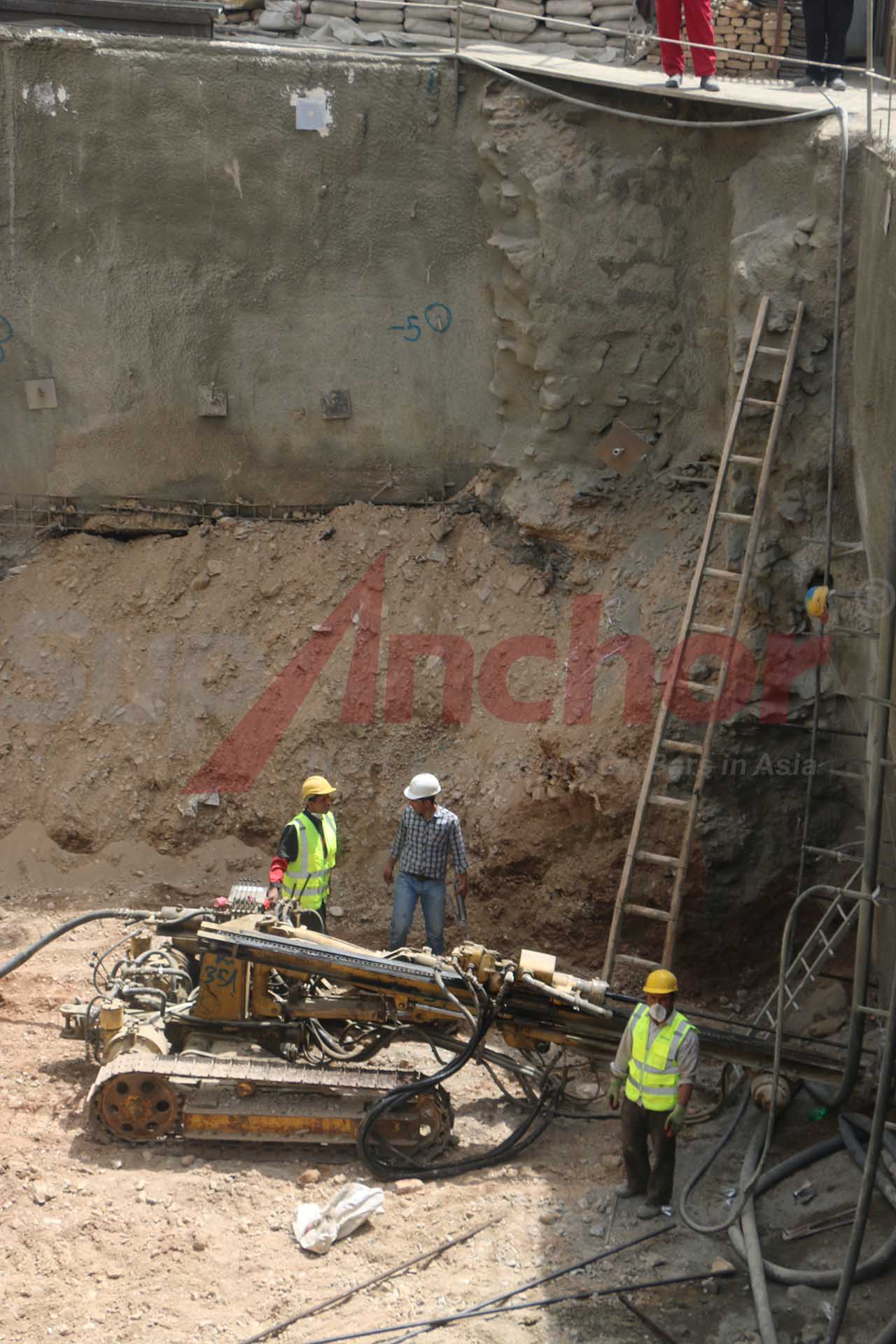
The site photograph shows one of the four active work faces during morning shift. A compact hydraulic rotary-percussive drill rig, mounted on a crawler chassis, is advancing a SupAnchor bar into a near-vertical cut slope. The operator monitors rotation speed and feed pressure from a panel mounted at the side of the mast. A grout plant positioned off-frame supplies cement-based grout through a swivel adapter into the hollow core of the bar. As the sacrificial drill bit cuts through the weathered zone, grout exits through the bit ports and fills the annular space between the bar and the ground. This simultaneous process creates a rough, grouted bond zone that develops frictional resistance along the entire length.
For this project, the main anchor type was a continuous-thread hollow bar with an outer diameter of 38 mm and an inner diameter of 16 mm. The steel grade provided a minimum yield strength of 550 MPa and an ultimate tensile strength of approximately 680 MPa. Each bar was supplied in 3-meter sections and extended with energy-efficient couplers to reach depths of up to 18 meters in the deepest cut. The continuous ISO 10208 left-hand rope thread allowed standard nuts, plates, and couplers to be installed at any point along the bar, which simplified cutting and re-threading in the field.
The grout mix was a pumpable, low-bleed cement grout with a water-cement ratio of 0.40 to 0.45. Admixtures were used to improve flow and reduce shrinkage. Injection pressures were held between 0.5 and 1.5 MPa during drilling and increased to 2.0 MPa for post-grouting in zones of high permeability. In areas where groundwater was aggressive, a double corrosion protection system was specified, using a hot-dip galvanized bar plus a corrugated plastic sheath filled with grout. This ensured a design life of 100 years for permanent retaining wall anchors.
The table below summarizes the typical technical parameters of the SupAnchor self drilling anchor system used on this project, based on the manufacturer's published product range and the site-specific design requirements.
| Parameter | Specification / Range |
|---|---|
| Bar outer diameter | 25 mm – 51 mm (R32, R38, R51 commonly used) |
| Steel grade / yield strength | 550 – 660 MPa (typical hollow bar steel) |
| Ultimate tensile capacity | Up to 800 kN depending on diameter and steel grade |
| Standard section length | 2 m, 3 m, 4 m, 6 m; custom lengths on request |
| Maximum assembled length | 18 – 24 m with couplers; longer on special order |
| Thread profile | Continuous left-hand rope thread, ISO 10208 compatible |
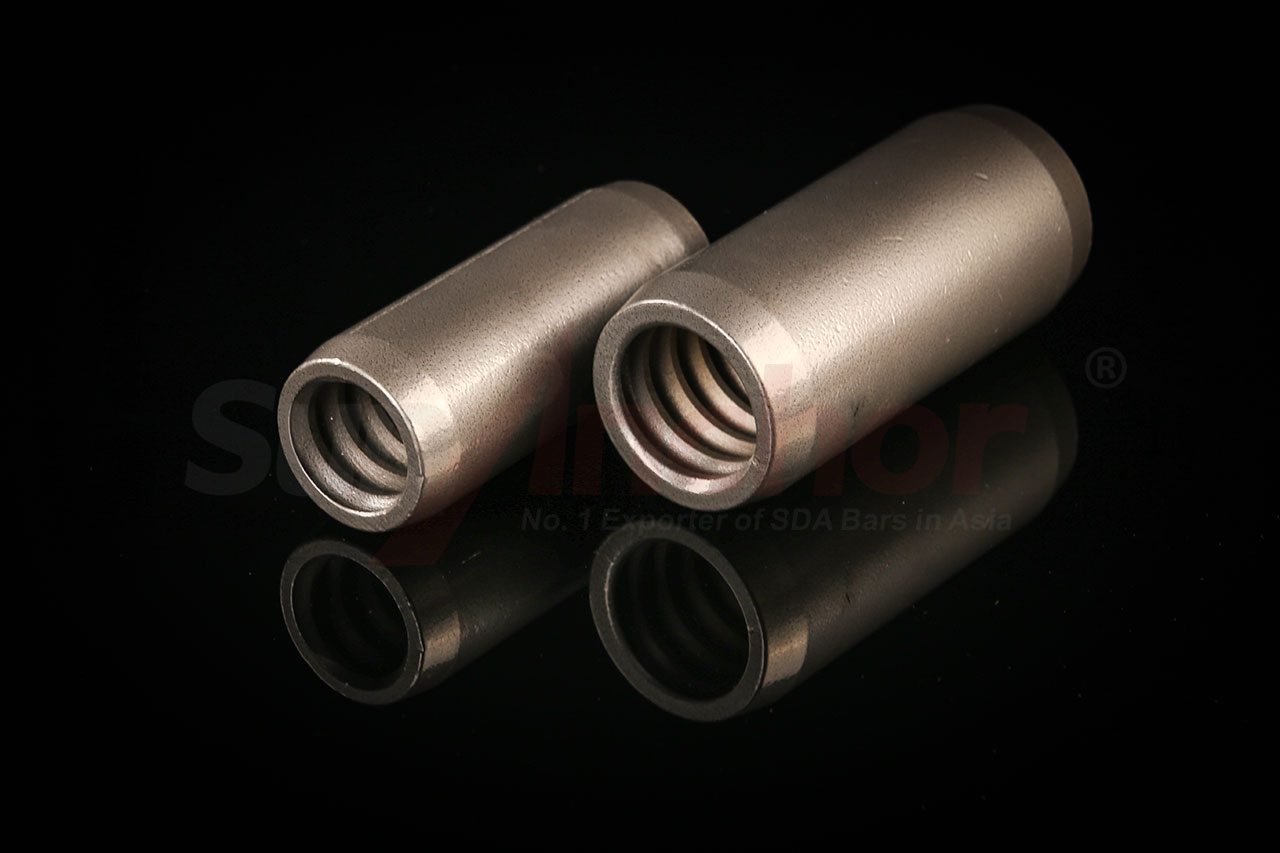
| Coupler type | Recessed or standard, with high fatigue resistance |
| Drill bit | Sacrificial cross-cut or carbide button bit matched to ground |
| Corrosion protection | Hot-dip galvanized, epoxy coating, or double corrosion protection |
| Applications | Slope stabilization, retaining walls, micropiles, tunnel forepoling, rock bolts |
These parameters illustrate how a self drilling anchor for retaining walls can be adapted to demanding ground conditions. The 38 mm bar selected for this project provided a balance between drilling stiffness and grout flow. In zones where higher loads were required, a 51 mm bar with an ultimate tensile capacity approaching 800 kN was installed, using a larger diameter drill bit and a higher-capacity rig. The continuous thread meant that the same bar could function as a soil nail, a rock dowel, or a tensioned anchor without changing the supply chain.
On the upper slope, temporary support was installed using 25 mm and 32 mm bars at 1.5-meter centers in a grid pattern. These self drilling bolts for civil engineering applications were installed at rates exceeding 120 meters per shift per rig, compared with 45 meters per shift for the original cased drilling method. The time savings not only improved schedule certainty but also reduced the exposure of workers to open excavations and moving equipment.
During installation, drill crews followed a strict sequence. First, the bar was fitted with a sacrificial drill bit and connected to the drill rig's rotation unit through a flushing adapter. The bar was then advanced into the ground at a rotation speed of 150 to 250 rpm, with feed force adjusted to the ground conditions. Water or air was used as the initial flushing medium until the bit passed the loose overburden. Once the bar reached the target depth, grout was injected through the hollow core while the bar was slowly withdrawn by about 0.3 to 0.5 meters to improve the bond zone at the bit end. The bar was then re-advanced to final depth, and grouting continued until clean grout returned at the collar. A bearing plate and nut were installed on the protruding thread, and the anchor was left undisturbed for at least 24 hours before tensioning.
This method contrasts sharply with conventional cased boring, where the casing is driven, the hole is cleaned, the bar is inserted, and the annulus is filled with grout in a separate operation. In the fractured rock and flowing water conditions on this project, cased holes often collapsed before the bar could be inserted, leading to lost holes and re-drilling. The self drilling method eliminated these risks because the bar and grout were present in the hole at all times.
Quality assurance on the project included daily grout cube tests, pull-out tests on sacrificial anchors, and load-displacement monitoring on selected production anchors. A total of 24 proof tests were performed, with results showing elastic displacement within 5% of theoretical values and no plastic deformation at 1.25 times the design load. Two anchors in a zone of high water flow were re-grouted using a tube-à-manchette system after initial testing indicated excessive creep, and both subsequently met acceptance criteria. This demonstrated the flexibility of the hollow bar anchor system to accommodate post-grouting even after initial installation.
Safety benefits were also significant. Because the drill rig and bar are lightweight, workers could handle sections without cranes, reducing lifting hazards. The immediate grouting process sealed the borehole, minimizing the risk of ground collapse and water inflow that had previously created unstable working conditions. Dust and noise were also lower than with conventional down-the-hole hammer drilling, which mattered because the site was close to a protected habitat area.
The use of hollow bar anchor technology is expanding across infrastructure, mining, and urban development as project owners seek faster, safer, and more reliable ground stabilization anchor system options. In Europe and North America, aging transportation networks are being upgraded with slope remediation and retaining structures that require anchors capable of penetrating difficult ground without vibration or excessive spoil. In underground mining, the same fundamental product—often specified as rock bolt for underground mining—is used for roof support in development headings and ore passes, where speed of installation is critical to production cycles.
Micropile hollow bar anchor applications are also growing in urban environments where low overhead clearance and vibration restrictions make conventional drilled shafts impractical. A self drilling anchor system can be installed with compact equipment, produces minimal spoil, and can be grouted immediately, reducing the risk of settlement adjacent to existing structures. These advantages align with global trends toward lower-carbon construction methods, because the elimination of temporary casing reduces steel consumption and shortens the construction window, thereby lowering total emissions from equipment operation.
The increasing complexity of geotechnical projects has also driven demand for an anchor bolt system for geotechnical engineering that integrates design software, load testing, and corrosion monitoring. On this mountain road project, every fifth production anchor was proof-loaded to 1.25 times the design load using a calibrated hydraulic jack. Deflection and residual movement were recorded, and two anchors in a highly fractured zone were re-grouted after initial creep exceeded project limits. This quality-control approach is now standard on major infrastructure works and reflects the growing maturity of self drilling anchor technology.
Across the Atlantic, transportation agencies are increasingly specifying self drilling anchors for emergency slope repairs after heavy rainfall events. In some European countries, national rail operators have standardized hollow bar anchors for tunnel portal stabilization and overhead line mast foundations, citing the reduced possession times and lower track access costs. These trends reflect a broader shift toward design-build procurement, where contractors are incentivized to adopt technologies that accelerate construction without compromising long-term performance.
The project also illustrates the economic logic of using a single supplier for both rock bolts and soil nails. By sourcing from a ground anchor bolt factory with a comprehensive product range, the contractor reduced the number of interfaces, simplified logistics, and ensured that all components—bars, couplers, plates, nuts, and drill bits—were fully compatible. This integration is particularly valuable on remote sites where resupply is difficult and equipment downtime is expensive.
SupAnchor, positioned as a soil nail system manufacturer and ground anchor bolt factory, has supplied self drilling anchor systems to infrastructure projects in more than 40 countries. The company's manufacturing facilities are certified under ISO 9001 quality management systems, and its products are tested to international standards including EN 14199, ISO 10208, and ASTM specifications where applicable. The continuous-thread hollow bar used on this project was produced from high-quality alloy steel and subjected to tensile, shear, and fatigue testing prior to shipment.
What sets SupAnchor apart in this project was not just the product, but the collaborative engineering support. Company engineers worked with the contractor to select the appropriate drill bit geometry for the mixed ground, recommended coupler configurations to reduce eccentricity during drilling, and provided on-site training for the drill rig operators. This level of support is increasingly important as contractors adopt SDA bolt factory direct supply models to reduce lead times and ensure traceability of materials.
Looking ahead, SupAnchor continues to invest in product development for challenging ground. Recent innovations include higher-strength hollow bar grades, improved coupler fatigue performance, and epoxy-based coating systems that withstand aggressive sulfate and chloride environments. The company's quality assurance laboratory conducts full-scale tensile tests, cyclic loading tests, and corrosion resistance tests to validate product performance before release. This commitment to rigorous testing aligns with the requirements of ISO 17025-accredited third-party certification bodies used on major infrastructure projects.
The project is now in the final phase, with permanent anchors installed and slope instrumentation showing deformation well within design limits. The client's project manager noted that the switch to a self drilling anchor system reduced the foundation support schedule by six weeks and avoided the need for two additional cased drilling rigs. Such outcomes are driving broader adoption of the technology across the civil engineering sector.
For owners, designers, and contractors facing difficult ground, the lesson from this project is clear: a well-engineered geotechnical reinforcement system that combines drilling, grouting, and anchoring can deliver measurable gains in speed, safety, and long-term performance. SupAnchor's self drilling anchor system, backed by a global supply chain and rigorous testing, is positioned to support the next generation of infrastructure and mining projects around the world.
Industry report on SupAnchor's self drilling anchor system used in a challenging slope stabilization and foundation support project, highlighting technical parameters and global geotechnical trends.
SupAnchor's GFRP hollow injection bolts deliver high tensile strength and full grouting in a challenging Alpine tunnel, showcasing advanced geotechnical reinforcement systems for modern infrastructure.
SupAnchor's self drilling anchor system delivers efficient ground stabilization in a large-scale infrastructure project, offering technical advantages in difficult geological conditions.
SupAnchor unveils SupFRP® GFRP reinforcement rebar offering high tensile strength, corrosion resistance, and versatility for soft-eye excavation, sea walls, and precast elements. Learn about specs and applications.
SupAnchor's self drilling anchor system has been successfully deployed on a highway slope stabilization project in Europe, overcoming fractured rock and loose soil conditions with high-strength hollow bar anchors and drill-and-grout technology.