
In a rugged terrain where loose overburden and fractured bedrock posed severe risks to infrastructure, a recent geotechnical project turned to SupAnchor’s advanced self-drilling anchor system to secure a critical slope. The project, located in a seismically active region, required rapid yet robust ground stabilization to protect a newly constructed highway. The choice of SupAnchor’s hollow bar anchors, a leading geotechnical reinforcement system, proved instrumental in overcoming the complex subsurface conditions. This self drilling anchor bolt technology is increasingly recognized in civil engineering for its efficiency and reliability under demanding circumstances.
The site’s geology featured alternating layers of weathered shale and clayey sandy soil, with groundwater seepage exacerbating instability. Initial assessments indicated that traditional anchored systems would be time‐consuming and risky due to the high probability of borehole collapse. Faced with a tight construction window and stringent environmental regulations, the project’s designers specified a ground stabilization anchor system that could be installed rapidly without generating excessive spoils or vibrations. SupAnchor’s solution—a drill-and-grout bolt that combines drilling, grouting, and anchoring in one continuous operation—offered the ideal answer. Not only did it minimize traffic disruption on the adjacent highway, but it also ensured long-term slope integrity in an area known for seasonal landslides.
The slope in question formed part of a $120 million highway expansion intended to ease congestion between two major economic zones. However, the 80-meter-high cut slope, with an inclination of 65°, was one of the most unstable sections along the 12-kilometer alignment. Geotechnical investigations revealed a complex profile: a top layer of colluvium (1–3 m thick), underlain by highly fractured phyllite with occasional lenses of bentonite clay. The clay layers, when saturated, exhibited swelling behavior that could trigger progressive failure. Moreover, the seismic hazard maps indicated a peak ground acceleration of 0.35g, demanding a retaining structure capable of resisting both static and dynamic loads.
Conventional ground anchors would have required temporary casing to prevent hole collapse during drilling, followed by separate grouting and tensioning steps. This triple-phase approach would have extended the schedule by months and significantly increased the cost. In contrast, a self drilling anchor for retaining walls allows the hollow bar anchor to act as both the drill rod and the permanent tendon. The sacrificial drill bit is left in the hole, and the injected grout flows through the hollow core to fill the annulus immediately. This simultaneous process eliminates the risk of borehole washout and guarantees a consistent bond with the surrounding soil and rock. The selection of SupAnchor as the soil nail system manufacturer also meant that the project benefited from a factory-direct supply chain, reducing lead times and ensuring traceable quality for every self drilling bolt.
Construction crews mobilized a fleet of hydraulic rotary-percussive drilling rigs fitted with high-torque heads. Each rig was equipped with SupAnchor R38 hollow bars—a micropile hollow bar anchor with a nominal diameter of 38 mm. The installation sequence reflected the essence of the hollow bar anchor methodology. First, the drill bit, mounted on the leading bar, penetrated the colluvium and fractured rock at an angle as steep as 15° from horizontal. As drilling progressed, a neat cement grout (water/cement ratio 0.4–0.5) was pumped through the hollow core at a pressure of 1–2 MPa. This grout flushed out cuttings and permeated the surrounding ground, creating a grout-soil/rock column with superior shear resistance.
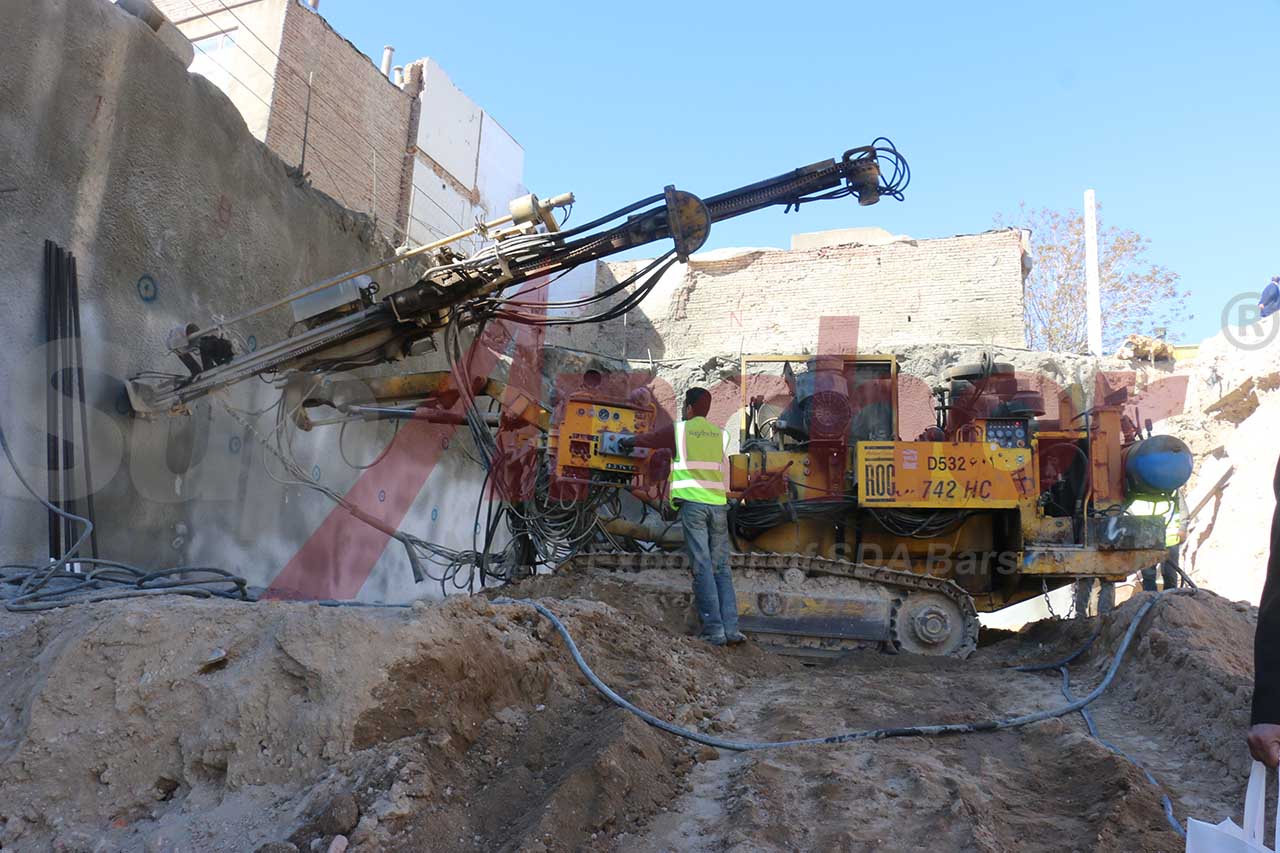
As the accompanying photograph shows, a crew member carefully monitors the grout return and the alignment of the anchor. The image captures the moment during installation when the bar has reached its design depth, and excess grout emerges at the surface, indicating full encapsulation. This visual confirmation of grout continuity is a critical quality-control checkpoint, especially in variable ground conditions. In areas where the bentonite clay caused excessive squeezing, the operators increased the revolutions per minute while reducing the feed pressure, thus preventing the drill string from getting stuck. The entire cycle—from drilling to grout set—required on average only 45 minutes per 12-meter anchor, an impressive rate that kept the project ahead of schedule.
Over 200 individual anchors were installed in a grid pattern (2.0 m center-to-center spacing vertically and horizontally) across the slope face. Each anchor was designed for a working load of 350 kN, with a safety factor of 2.0, yielding an ultimate tensile strength requirement of at least 700 kN. Post-installation, the anchors were connected to a reinforced shotcrete facing, creating a composite “soil nail” system that evenly distributed loads. The entire reinforcement system effectively transformed the potentially unstable slope into a coherent mass capable of withstanding seismic events without excessive deformation.
The success of the project hinged on precise engineering. The table below outlines the key parameters of the self drilling anchor system deployed, as supplied directly from the ground anchor bolt factory.
| Parameter | Specification |
|---|---|
| Anchor Type | Hollow Bar Anchor (R38 thread) |
| Nominal Diameter | 38 mm |
| Ultimate Tensile Strength | ≥ 660 MPa |
| Yield Strength | ≥ 500 MPa |
| Elongation | ≥ 15% |
| Corrosion Protection | Hot-dip galvanized (≥ 70 μm) + optional epoxy coating |
| Thread Length Options | 2 m, 3 m, 4 m, 5 m, 6 m (coupled) |
| Grout Strength | ≥ 30 MPa (28-day) |
These specifications were deliberately chosen to match the predicted loads and aggressive site environment. The 660 MPa ultimate tensile strength provided ample capacity for the 350 kN working load, while the high yield ratio ensured that the bar would exhibit early warning signs (elongation) before rupture. The hot-dip galvanized coating—applied at the SDA bolt factory direct supply—offered robust protection against the mild acidity of the local groundwater (pH 5.5–6.5), extending the design life to 75 years. Additionally, the threaded coupling system allowed easy transportation and handling of long anchors, which were assembled piece by piece at the bench. This flexibility is a hallmark of an anchor bolt system for geotechnical engineering that must adapt to variable depth requirements across a single slope.
Unlike traditional tensioned anchors, a ground stabilization anchor system such as SupAnchor’s self drilling bolt for civil engineering applications offers several distinct advantages that stem from its integrated design.
These qualities make the self drilling anchor system particularly attractive for transportation infrastructure projects, where lane closures and traffic delays impose steep financial penalties. By completing the slope stabilization in just 12 weeks—versus an estimated 28 weeks for traditional tied-back walls—the contractor not only met the contractual milestone but also saved the client substantial liquidated damages. Furthermore, the reduction in spoil generation (no drill cuttings to dispose of) aligned with the project’s green construction goals, earning commendation from local environmental agencies.
As the global population urbanises, investment in transportation networks, clean energy, and climate-resilient infrastructure continues to surge. According to industry analysts, the global geotechnical engineering market is projected to grow at a compound annual rate of 6.2% through 2030, with slope stabilization and retaining structures forming a significant portion of that demand. The project described here exemplifies how an advanced geotechnical reinforcement system can simultaneously address schedule, budget, and durability requirements—a trifecta that governments and private developers increasingly expect.
The use of SDA bolt factory direct supply illustrates a broader trend toward integrated supply chains in construction. By procuring anchors directly from the soil nail system manufacturer, the project team reduced the risk of counterfeit materials and gained access to in‐house technical support during installation. This collaboration between designer, contractor, and factory ensures that the anchor bolt system for geotechnical engineering is optimized for specific site conditions, rather than being a one‐size‐fits‐all solution. As codes and standards evolve—such as Eurocode 7 and the upcoming revisions to BS 8081—the traceability and performance data that accompany factory-supplied anchors will become even more critical.
Moreover, the concept of self-drilling anchors contributes to the growing emphasis on sustainable construction. By minimizing spoil and eliminating the need for temporary works (casing, guide walls), the carbon footprint of the anchoring operation is significantly reduced. Combined with the extended service life provided by high-quality corrosion protection, these systems lower the whole-life cost of infrastructure. More and more departments of transportation are therefore specifying self drilling anchor systems for use in highway cuts, bridge abutments, and tunnel portals—a shift that is reshaping procurement practices and fostering innovation among ground anchor bolt factories.
Behind this project’s success stands SupAnchor, a company with over two decades of singular focus on anchor technology. Holding ISO 9001, ISO 14001, and OHSAS 18001 certifications, the manufacturer has delivered more than 1,200 projects across 40 countries. Its portfolio spans seismically retrofitted dams in Japan, metro station excavations in Singapore, and rock fall protection networks in the Swiss Alps. What sets SupAnchor apart is a deep commitment to the principle of “Professional, Innovative, Collaborative.” The company’s engineers work hand-in-glove with clients from the design phase through to on-site commissioning, ensuring that each self drilling anchor bolt is tailored to the task.
“Our goal is not merely to supply components but to provide a complete geotechnical solution,” explains a senior technical manager at SupAnchor. “By controlling every step—from steel sourcing and heat treatment at our ground anchor bolt factory to final threading and coating—we can guarantee performance that meets or exceeds global standards.” This vertical integration also allows the firm to innovate rapidly. Recent developments include a new duplex corrosion protection system that combines hot-dip galvanizing with a fusion-bonded epoxy outer layer, achieving a design life of 100 years even in aggressive marine environments. SupAnchor has also pioneered intelligent monitoring packages where strain gauges are embedded within selected hollow bars, transmitting real-time load data to a cloud-based dashboard—a glimpse into the future of “smart” geotechnical reinforcement.
The company’s dedication to quality and continuous improvement has earned it preferred-supplier status with several multinational construction corporations. As one project director noted, “When you’re hundreds of meters deep in a tunnel or working on a slope above a busy highway, you cannot afford any doubt about your ground support. That’s why we keep coming back to SupAnchor.” This sentiment echoes across the industry, positioning the firm at the vanguard of anchor bolt system for geotechnical engineering advances.
The slope stabilization project stands as a testament to how innovative ground stabilization techniques can overcome nature’s most stubborn barriers. With SupAnchor’s self drilling anchor system at the heart of the solution, the highway now operates safely, even during monsoon seasons—proving once more that collaboration between engineering ingenuity and high-performance manufacturing is the key to sustainable infrastructure.
A European highway project overcame fractured rock and groundwater challenges using SupAnchor's self drilling anchor system. The hollow bar anchors provided rapid installation and high load capacity, showcasing innovation in geotechnical reinforcement.
SupAnchor introduces the SupFRP® GFRP Friction Bolt, a world-first corrosion-resistant, lightweight, and non-conductive ground support solution for mining and tunneling.
A major mountain highway expansion in the European Alps utilized SupAnchor's self drilling anchor system to overcome fractured rock and loose soil, ensuring long-term slope stability and construction safety.
SupAnchor's Grade 75 self-drilling hollow anchor bars deliver high bond strength, ASTM A615 compliance, and full compatibility with R/T thread systems for demanding geotechnical projects.
A self drilling anchor system from SupAnchor has been deployed in a challenging mountain infrastructure project, overcoming fractured rock and unstable slopes while reducing installation time and improving long-term ground stabilization.