In a rugged terrain characterized by fractured bedrock and loose colluvium, a major European transportation corridor has turned to SupAnchor's advanced geotechnical reinforcement system to secure unstable slopes. The project, located along a vital highway link in the Alpine foothills, required a robust anchoring solution capable of withstanding high lateral earth pressures while minimizing disturbance to the surrounding environment. SupAnchor, an ISO-certified manufacturer, supplied its self drilling anchor system, a technology that combines drilling, anchoring, and grouting in a single operation.
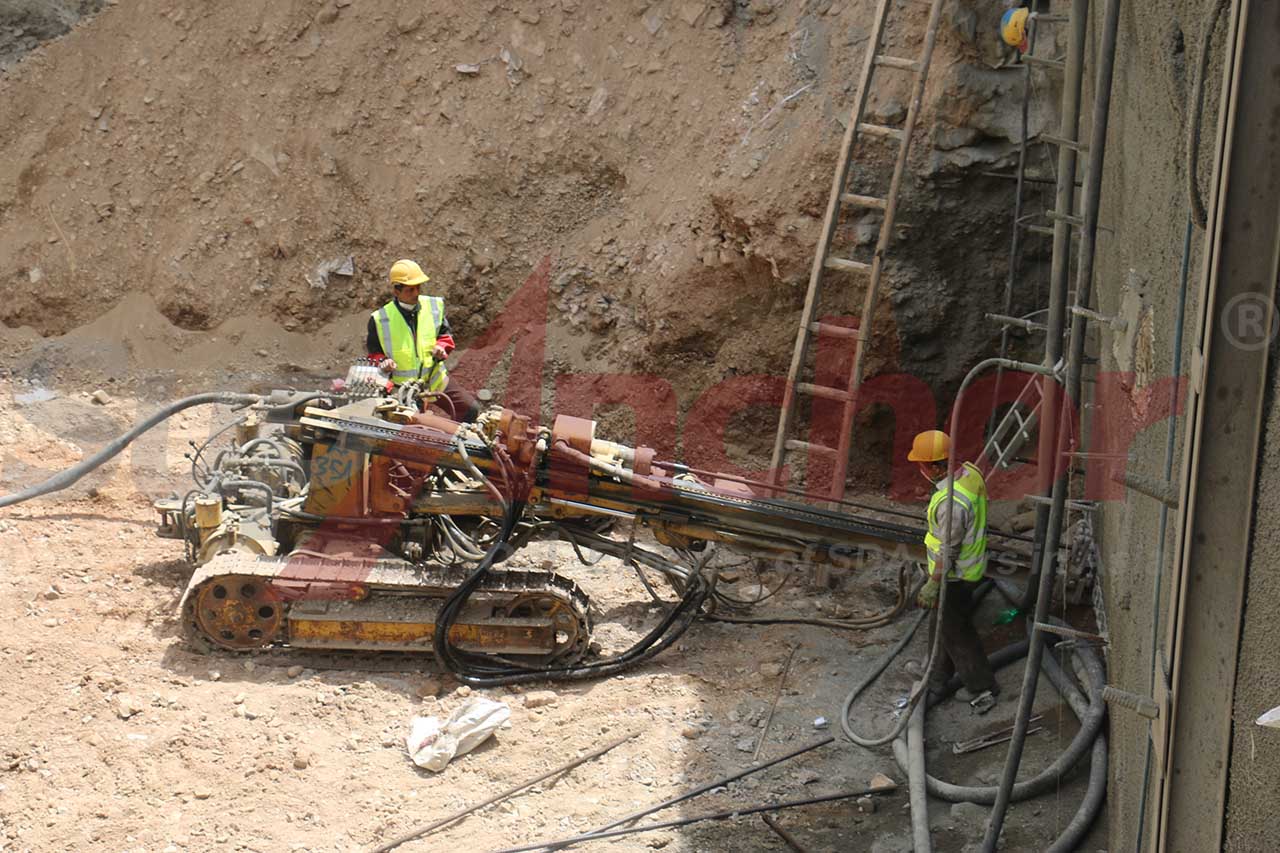
The construction site image above shows the deployment of the self drilling anchor bolt into a near-vertical cut slope. Workers are using a hydraulic rotary-percussive drill rig to install the hollow bar anchor through loose overburden and weathered rock. This method eliminates the need for pre-drilled holes and casing, a critical advantage in collapsing ground where conventional drilling would cause hole collapse and loss of grout. By using a drill-and-grout bolt, the contractor can advance the anchor while simultaneously injecting cement grout through the hollow core, creating a strong bond with the surrounding soil and rock.
According to the project geotechnical engineer, the site exhibited significant heterogeneity: alternating layers of sandstone, shale, and unconsolidated slope debris. Groundwater seepage was also encountered, which further complicated conventional drilled shaft installation. The self drilling anchor system allowed for immediate installation without temporary casing, reducing both time and cost. Moreover, the system's ability to be extended with couplers enabled anchors of up to 18 meters in length, sufficient to reach stable bedrock beyond the failure plane.
The slope stabilization project is part of a broader infrastructure upgrade aimed at improving road safety and resilience in a region prone to landslides. The original slope, with an inclination of approximately 60 degrees, had shown signs of progressive movement following heavy rainfall events. Surface cracks and small-scale slumps indicated an active shallow failure mechanism. A detailed site investigation revealed a complex stratigraphy: a thin layer of topsoil, underlain by 3 to 5 meters of loose colluvium, followed by highly fractured bedrock with RQD values often below 25%.
Traditional ground anchor systems would have required cased boreholes to prevent collapse, adding significant time and expense. Moreover, the remote location and environmental constraints limited the use of large drilling equipment. The project owner sought a solution that could be installed quickly, with minimal vibration and noise, and that could guarantee long-term durability against corrosion. SupAnchor's self drilling anchor bolt was selected after a rigorous technical evaluation.
The self drilling anchor system offered several distinct advantages. First, its hollow construction allows simultaneous drilling and grouting, which stabilizes the borehole immediately. Second, the anchor bar itself serves as the drill string, eliminating the need for a separate drill rod and casing. Third, the system can be installed in a wide range of ground conditions, from soft soils to hard rock, by selecting appropriate drill bits and thread types. These features made it ideal for the variable conditions encountered at the site.
On site, the installation process began with the positioning of a compact excavator-mounted drill rig. The SupAnchor SDA (Self Drilling Anchor) bars, supplied in 3-meter sections, were coupled together as drilling progressed. A sacrificial drill bit, selected based on the anticipated ground conditions, was attached to the leading bar. The hollow core allowed cement grout to be pumped under pressure through the bar and out through the drill bit's flushing holes, filling the annular space and penetrating fractures in the rock mass.
The image above captures a critical moment during installation: the operator is monitoring the grout return at the collar, ensuring that the borehole is fully grouted and no voids remain. This real-time grouting capability is a key benefit of the drill-and-grout bolt method, as it provides immediate verification of anchor integrity.
The following table summarizes the main technical parameters of the SupAnchor self drilling anchor bolt used in this project:
| Parameter | Value |
|---|---|
| Ultimate tensile strength | 660 MPa |
| Yield strength | 525 MPa |
| Outer diameter | 32 mm (R32 thread) |
| Length per section | 3,000 mm (can be coupled to 18 m+) |
| Corrosion protection | Hot-dip galvanized + epoxy coating |
| Grouting method | Simultaneous drilling and grouting through hollow core |
| Thread type | R32, suitable for soft to medium rock |
The high tensile strength of 660 MPa provides a substantial safety margin, allowing the anchor to resist both static and dynamic loads. The 32 mm diameter was selected to balance load capacity with ease of drilling through the fractured rock. The hot-dip galvanized and epoxy coating ensures a service life of at least 50 years in aggressive soil conditions, meeting the project's durability requirements. In addition, the R32 thread profile offers excellent bonding with the grout and easy coupling, reducing installation time and improving load transfer.
By using a self drilling anchor bolt with these specifications, the contractor was able to achieve an average installation rate of 15 anchors per shift, significantly faster than conventional methods. The simultaneous grouting also minimized grout loss, a common problem in fractured rock, and reduced the environmental footprint by eliminating the need for temporary casing and disposal of drill cuttings. This efficiency translated into a shorter project schedule and lower overall cost, while maintaining the highest safety standards.
The successful application of SupAnchor's geotechnical reinforcement system on this project reflects a broader industry shift toward more efficient and reliable ground stabilization methods. In Europe and North America, aging infrastructure and increasingly extreme weather events have heightened the demand for slope stabilization, retaining wall support, and foundation reinforcement. Traditional anchoring methods, while proven, often struggle in difficult ground conditions and can be cost-prohibitive.
This technology addresses these challenges by integrating drilling and anchoring into a single step. This technology, also known as a hollow bar anchor or a micropile hollow bar anchor, has gained widespread acceptance in tunneling, mining, and civil engineering. As a leading soil nail system manufacturer, SupAnchor has been at the forefront of this transition, supplying high-quality hollow bar anchors to projects worldwide. The system's versatility allows it to be used in a variety of applications, from temporary excavation support to permanent slope stabilization.
In underground construction, the use of this anchoring technology has expanded beyond slope stabilization. For example, in tunneling, these anchors are used for face stabilization and forepoling, where ground conditions are too weak for conventional support. In mining, the rock bolt for underground mining applications benefits from the same principle: these anchors can be installed quickly in fractured rock, providing immediate support to the excavation. The hollow bar anchor's ability to be grouted simultaneously ensures full encapsulation, which is critical for long-term performance and corrosion protection.
Another growing application is the use of self drilling anchor for retaining walls. In congested urban environments, where excavation space is limited, these anchors allow for the construction of anchored retaining walls without the need for large, heavy drilling equipment. The ground stabilization anchor system can be installed at various angles, providing flexibility in design. This is particularly valuable in projects where adjacent structures or utilities restrict access. Moreover, the low vibration and noise levels associated with self drilling anchors make them suitable for use in urban areas where disturbance to nearby buildings and residents must be minimized.
Furthermore, the development of self drilling bolt for civil engineering has enabled the repair and upgrade of existing structures. For example, bridge abutment reinforcement, tunnel lining repair, and dam stabilization often require anchors that can be installed in confined spaces with minimal vibration. The self drilling anchor system meets these requirements, making it a preferred choice for retrofit projects. Its ability to be installed through existing structures without the need for large rigs further enhances its value in the civil engineering sector.
From a global perspective, infrastructure investment is expected to increase significantly in the coming decades. Governments and private developers are seeking solutions that offer both technical performance and economic efficiency. The self drilling anchor system, with its combined drilling and grouting capability, reduces the number of construction steps, shortens project timelines, and lowers labor costs. These advantages are driving its adoption across the globe, particularly in regions with challenging geology or where environmental concerns require minimal disturbance.
SupAnchor has established itself as a trusted ground anchor bolt factory with a global footprint. Headquartered in China, the company operates a state-of-the-art manufacturing facility equipped with automated production lines and rigorous quality control systems. All products are manufactured in accordance with ISO 9001 standards and are CE certified, ensuring compliance with European safety and performance requirements. As a leading SDA bolt factory direct supply, SupAnchor offers competitive pricing without compromising on quality. The company's commitment to excellence is reflected in its comprehensive testing procedures, including tensile testing, dimensional inspection, and corrosion resistance testing on every batch of anchors.
The company's commitment to innovation is evident in its continuous development of new products and technologies. The self drilling anchor system is a prime example of this innovation, combining high-strength steel with corrosion protection coatings and optimized thread profiles. SupAnchor's engineering team works closely with clients to provide customized solutions, from anchor design to on-site technical support. This collaborative approach has earned the company a reputation for reliability and expertise in the geotechnical industry.
Globally, SupAnchor products have been used in a wide range of projects, including highway slope stabilization, deep excavation support, tunnel construction, and underground mining. In each case, the company's anchor bolt system for geotechnical engineering has delivered measurable benefits: faster installation, reduced cost, and enhanced safety. The project described in this article is just one example of how SupAnchor's technology is helping to build resilient infrastructure.

As the construction industry continues to demand more efficient and sustainable solutions, the role of advanced geotechnical products will only grow. SupAnchor remains dedicated to the principles of professionalism, innovation, and collaboration, ensuring that every project benefits from the latest advancements in anchor technology. For contractors and engineers seeking a reliable partner for ground stabilization, SupAnchor's proven anchoring technology offers a proven, cost-effective, and technically superior choice.
European slope project uses SupAnchor self drilling anchor system to stabilize fractured ground with simultaneous drilling and grouting.
SupAnchor's T thread self-drilling hollow anchor revolutionizes geotechnical reinforcement in challenging tunneling projects, delivering high load capacity, corrosion resistance, and rapid installation.
SupAnchor's self drilling anchor system successfully addressed challenging weathered rock conditions in a European highway slope stabilization project, demonstrating high efficiency and reliability.
SupAnchor launches high-performance GFRP reinforcement rebar with high corrosion resistance, tensile strength up to 1000 MPa, and wide applications in bridges, seawalls, and precast elements.
A new ground stabilization project in rugged terrain highlights the efficiency and reliability of SupAnchor's self drilling anchor bolt system, designed for complex geotechnical conditions.