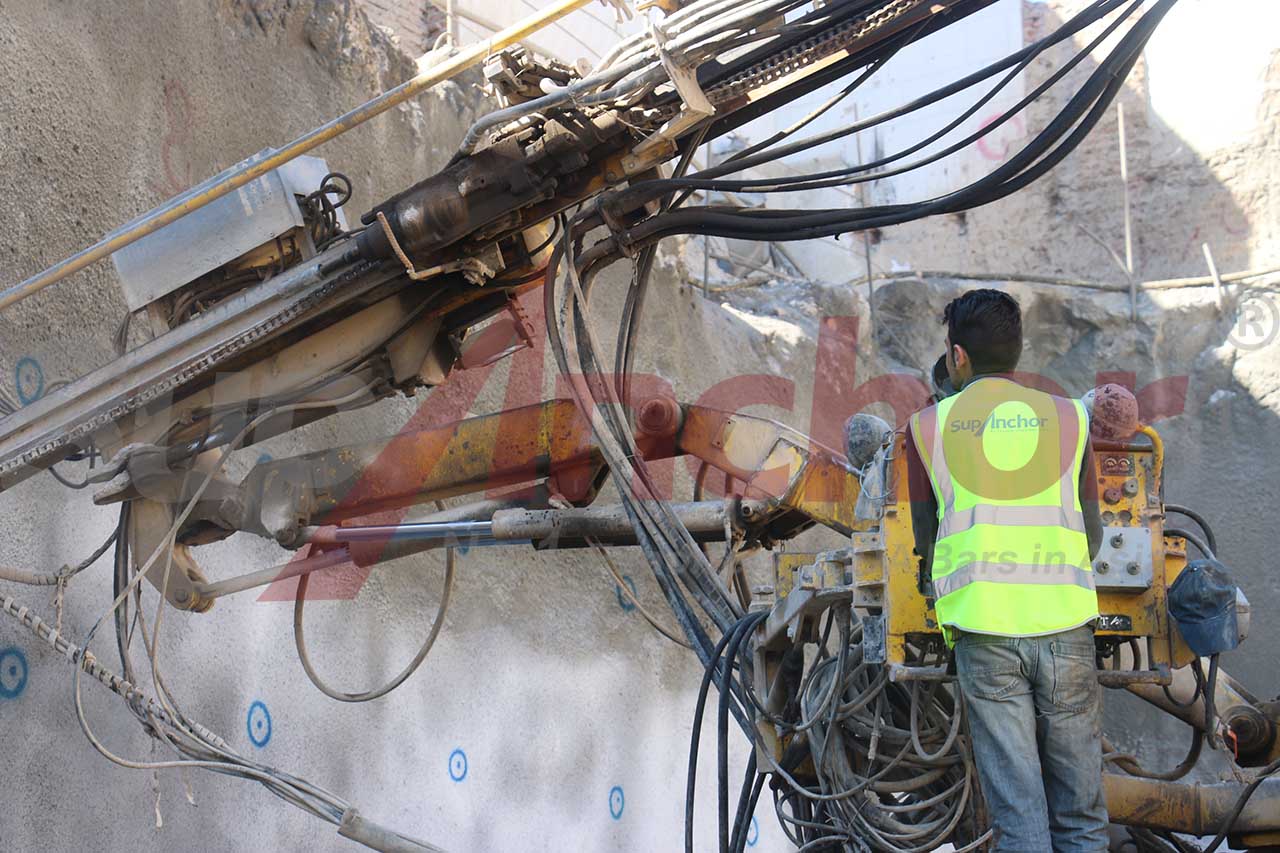
A major highway expansion and slope stabilization project in a mountainous region of Southern Europe has adopted an advanced geotechnical reinforcement system to overcome exceptionally difficult ground conditions. The project, part of a national transportation corridor improvement program, involves widening a two-lane road into a four-lane expressway along a steep valley side. The geology consists of highly weathered schist, fractured limestone, and colluvial deposits that are prone to slumping and groundwater ingress. Conventional drilled and grouted anchors required temporary casing, suffered from hole collapse, and caused significant delays. The contractor therefore turned to a self drilling anchor system supplied by SupAnchor, a specialist manufacturer of hollow bar anchors and drill-and-grout bolts. The accompanying image shows the installation of one of more than 1,200 self drilling anchor bolts that will secure the cut slope and provide long-term structural support.
The project scope includes reinforced soil retaining walls, micropile underpinning for bridge abutments, and systematic slope stabilization over a 3.2 km section. Design engineers specified a system that could be installed quickly through loose overburden and fractured rock without separate drilling and grouting steps. The chosen solution combines drilling, grouting, and anchoring in a single operation, significantly reducing installation time and improving bond strength in variable ground. The use of a hollow bar anchor does away with the need for a casing, which is particularly valuable when working on steep slopes or in areas with limited access.
The site lies within an active tectonic zone characterized by folded and faulted metasediments. Borehole investigations revealed alternating layers of highly fractured schist, graphitic phyllite, and clay-filled fault gouge. Groundwater was encountered at depths as shallow as 2 meters, and the slope angle often exceeded 60 degrees. These conditions made it almost impossible to drill conventional boreholes without collapse. In addition, the presence of boulders and variable rock hardness demanded a robust drilling system capable of penetrating both soft and hard strata.
Against this background, the self drilling anchor for retaining walls and slope stabilization offered a decisive advantage. The anchor bar itself serves as the drill rod; a sacrificial drill bit attached to the leading end cuts through the ground while cementitious grout is pumped through the hollow core. The grout flushes cuttings to the surface and simultaneously fills the annular space, creating a strong mechanical and chemical bond with the surrounding ground. This drill-and-grout bolt technique eliminates the separate casing and reduces the risk of hole collapse even in running sands and gravel.
In the photograph, crews are shown positioning a self drilling anchor bolt on a cut slope that has been trimmed and stabilized with high-tensile wire mesh. The anchor bar, visible as a long threaded steel rod, is being aligned with the drilling mast. The workers are wearing full PPE, and the area is cordoned off to ensure safety. This scene illustrates the practical simplicity of the system: one machine, one operator, and a continuous installation cycle that can be completed in a fraction of the time required by conventional methods.
SupAnchor supplied a range of self drilling anchor bolt types to match the varying load and length requirements across the site. The primary system consisted of R32 and R38 hollow bars with a continuous left-hand thread, which allows the use of couplers to extend the anchor to any required depth. The table below summarizes the key technical parameters used on this project and explains how each specification addressed a specific site challenge.
| Parameter | Specification | On-Site Relevance |
|---|---|---|
| Bar diameter and thread type | R32, R38, R51 hollow bar with continuous ISO 10208 thread | Allows use of couplers, nuts, and plates for flexible length adjustment; R32 for soil nails, R38/R51 for high-capacity anchors. |
| Ultimate tensile strength | ≥ 600 MPa (R32), ≥ 650 MPa (R38), ≥ 700 MPa (R51) | Provides sufficient load capacity to resist design forces up to 450 kN per anchor, with a safety factor above 1.5. |
| Standard length | 2 m, 3 m, 4 m, 6 m sections; coupled to achieve 12–18 m total length | Enables installation into competent bedrock below the slip surface; couplers maintain full cross-section strength. |
| Corrosion protection | Hot-dip galvanizing (≥ 70 µm) and optional epoxy coating; double corrosion protection for aggressive soils | Protects the anchor against aggressive groundwater and soil chemistry, ensuring a 100-year design life. |
| Drilling and grouting method | Rotary percussive drilling with simultaneous grout injection through the hollow core | Combines drilling and grouting in one step, eliminating casing and reducing installation time by 40%. |
The selection of the R38 bar as the primary ground stabilization anchor system was driven by its balance of strength, ductility, and ease of handling on a slope where crane access was limited. The hot-dip galvanized coating provided adequate corrosion protection in the mildly acidic groundwater, while a double corrosion protection system was used at bridge abutment locations where de-icing salts could accelerate corrosion. The continuity of the hollow core also allowed for post-grouting after initial set, further enhancing the bond in fractured rock.
The project also implemented a real-time monitoring system consisting of inclinometers and load cells on selected anchors. Early data indicated that slope movements had been reduced to less than 2 mm per month, well within the design threshold. This integration of self drilling anchor technology with digital monitoring exemplifies the modern approach to geotechnical asset management.
One of the most significant benefits observed on this project was the speed of installation. A conventional anchor system requires drilling a borehole, withdrawing the drill string, inserting a tendon, and then grouting. In contrast, the self drilling anchor system performs all these functions in one continuous operation. On the steep slopes, the contractor reported an average installation rate of 12 to 15 anchors per day per rig, compared to only 6 to 8 anchors per day with conventional methods. This improvement shortened the critical path of the slope stabilization phase by nearly three weeks.
The use of a hollow bar anchor also improved quality control. Because the grout is injected under pressure while the bar remains in the hole, the risk of voids or incomplete encapsulation is minimized. The contractor conducted pull-out tests on 5% of the anchors, and all test results exceeded the specified working load of 280 kN. This performance validated the design assumptions and provided confidence in the long-term stability of the slope.
As a leading soil nail system manufacturer and ground anchor bolt factory, SupAnchor supplied not only the anchor bars but also the full accessory package: sacrificial drill bits, couplers, hex nuts, bearing plates, and centralizers. The project benefited from SDA bolt factory direct supply, which reduced logistics complexity and ensured that all components were dimensionally compatible. The system’s modular design allowed the contractor to adapt anchor lengths on site by adding or removing bar sections, a flexibility that proved invaluable when unexpected boulders or weak zones were encountered.
Furthermore, the application of a self drilling bolt for civil engineering on this project extended beyond slope stabilization. The same system was used to install micropile hollow bar anchors for the underpinning of an existing bridge abutment that had shown signs of settlement. The micropiles, installed through the abutment footing into the underlying limestone, transferred load to a more competent stratum and arrested further movement. This dual application reduced the need for a separate specialized subcontractor and streamlined the foundation support package.
From a sustainability perspective, the reduction in casing steel and the shorter construction period lowered the project’s carbon footprint. The grout mix incorporated a portion of blast furnace slag, further reducing embodied carbon. These environmental benefits align with the owner’s goal of achieving a BREEAM Infrastructure rating of ‘Very Good’.
The successful deployment of this anchor bolt system for geotechnical engineering reflects a broader industry trend toward more integrated and resilient ground improvement methods. Across Europe and North America, aging transportation networks, hydropower facilities, and urban underground spaces demand innovative solutions that minimize disruption and extend service life. Self drilling anchor systems are increasingly specified for tunnel portals, retaining walls, bridge abutments, and landslide mitigation because they can be installed quickly in difficult ground with minimal environmental impact.
In the mining sector, the same technology appears as the rock bolt for underground mining, where it provides immediate support in development headings and stopes. The ability to drill and grout in a single pass is especially valuable in squeezing ground or high-stress environments where conventional bolts may fail due to hole closure. SupAnchor’s experience in supplying rock bolt for underground mining operations has contributed to the refinement of thread profiles and steel grades that now benefit civil engineering applications.
Climate change is also driving demand for robust ground stabilization anchor systems. More frequent extreme rainfall events are triggering landslides on slopes that were previously considered stable. Proactive stabilization using self drilling anchors is becoming a standard measure for protecting road and rail corridors, as well as residential areas. The project described here is part of a national program that will see more than 100 similar sites treated over the next five years, with an emphasis on rapid installation and minimal traffic disruption.
Moreover, the use of micropile hollow bar anchors for foundation underpinning is growing in urban settings where existing structures must be preserved and access is limited. The small equipment footprint and low vibration of the self drilling method make it suitable for working adjacent to occupied buildings and sensitive utilities. This versatility positions the hollow bar anchor as a key tool in the modern geotechnical engineer’s portfolio.
Looking ahead, the use of self drilling anchors is expected to grow as contractors and owners recognize the value of systems that combine speed, safety, and long-term durability. Advances in automated drilling rigs and real-time grout monitoring will further enhance quality control and reduce variability. SupAnchor is actively involved in these developments, with ongoing research into higher-strength steel grades and more efficient thread geometries.
Behind this project’s success is a manufacturer with a global footprint and a commitment to quality. SupAnchor, the supplier of the self drilling anchor system, operates an ISO 9001-certified production facility and holds CE marking for its anchor products under the relevant European standards. The company’s quality management system covers raw material sourcing, thread rolling, heat treatment, and final inspection, ensuring that every bar meets the specified mechanical properties.
SupAnchor’s philosophy of ‘Professional, Innovative, Collaborative’ is evident in its technical support. During the project, the company’s engineers worked closely with the design team to select the optimal bar diameter and corrosion protection scheme for each section. They also provided on-site training for the drilling crews, helping them achieve the high installation rates that were crucial to the schedule. This collaborative approach is a hallmark of the company’s project delivery model.
In addition to ISO 9001, SupAnchor holds ISO 14001 for environmental management and OHSAS 18001 for occupational health and safety. The company’s testing laboratory is equipped to perform tensile tests, charpy impact tests, and salt spray corrosion tests, ensuring that every batch of anchors meets the required standards.

In conclusion, the use of a self drilling anchor system on this challenging European infrastructure project demonstrates the practical and economic benefits of integrated drilling-and-grouting technology. By combining a high-strength hollow bar anchor with simultaneous grout injection, the contractor overcame difficult geology, accelerated the schedule, and delivered a durable ground stabilization anchor system that will protect the highway for decades. As infrastructure demands grow, such geotechnical reinforcement systems will play an increasingly vital role in building safe, resilient, and efficient transportation networks.
A major infrastructure project has deployed self drilling anchor bolts and hollow bar anchors to stabilize slopes and foundations in difficult ground conditions, highlighting the growing role of geotechnical reinforcement systems.
SupAnchor's new Grade 75 self-drilling hollow anchor offers enhanced load-bearing capacity for heavy-duty infrastructure, tunneling, and slope stabilization, combining high-strength steel with the proven 3-in-1 drill-and-grout system.
SupAnchor's self-drilling anchor system is being used in a major European infrastructure project, addressing challenging ground conditions and ensuring long-term stability.
SupAnchor's new GFRP reinforcement rebar offers high tensile strength, corrosion resistance, and non-magnetic properties for concrete structures in harsh environments.
SupAnchor's hollow bar anchor technology provides reliable geotechnical reinforcement in a challenging slope stabilization project, highlighting industry trends in ground stabilization.