In a major infrastructure upgrade along a new highway corridor in a mountainous region, contractors faced a 120-meter-long, 15-meter-high cut slope composed of loose colluvial deposits, weathered shale, and intermittent groundwater seepage. Traditional drilling methods proved inefficient due to borehole collapse and the need for temporary casing. The project team turned to SupAnchor, a leading soil nail system manufacturer and ground anchor bolt factory, to supply a self drilling anchor system that integrates drilling, grouting, and reinforcement into a single operation. The deployment highlights how modern geotechnical reinforcement systems can accelerate construction while delivering long-term ground stabilization anchor system performance under difficult conditions.
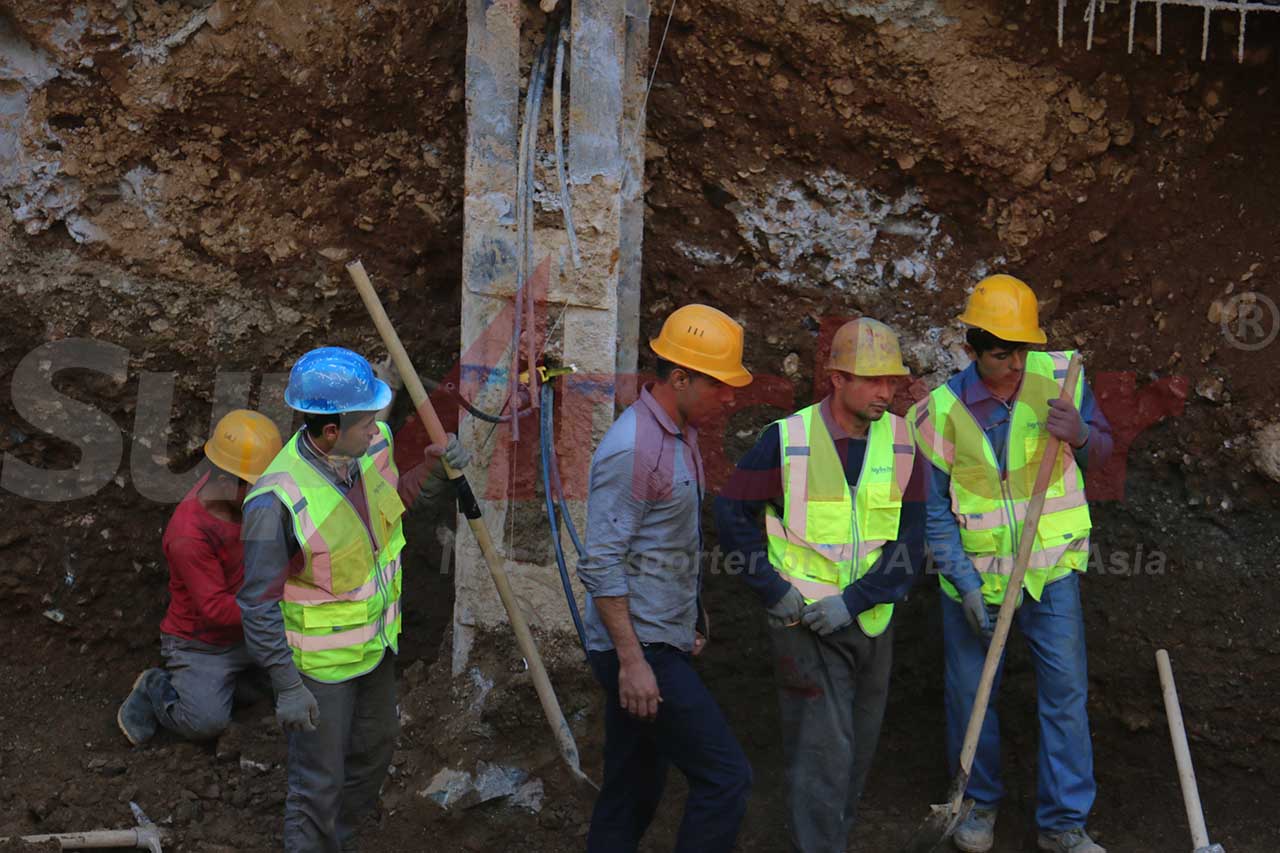
At the site, a compact hydraulic drill rig is shown advancing a hollow bar anchor through the overburden. The operator monitors torque and rotation speed while cement grout flows continuously through the bar's hollow core, exiting at the drill bit and filling the annulus from the bottom up. This drill-and-grout process eliminates the risk of hole collapse because the borehole is never left open. The visible grout return at the collar indicates complete encapsulation of the bar, a critical quality control checkpoint for bond strength.
The owner, a state transportation authority, required permanent stabilization for a cut slope that will carry a four-lane divided highway. Geotechnical borings revealed a complex profile: 0-4 m of silty sand and gravel with cobbles, underlain by 4-10 m of highly weathered shale with clay seams, and groundwater perched at 6 m depth. Slope stability analyses indicated a factor of safety below 1.0 under saturated conditions, necessitating reinforcement. The design called for 350 self drilling anchor bolts installed on a 2 m by 2 m grid, with 150 mm-thick reinforced shotcrete facing.
The primary challenge was maintaining borehole stability while drilling through the loose upper layer and the fractured shale. Conventional drilled and grouted anchors would require casing through the overburden, adding time and cost, and increasing the risk of grout loss into voids. The integrated one-pass method provided a solution: the hollow bar anchor serves as the drill rod, injection conduit, and tensile reinforcement. Couplers allow the bar to be extended to reach competent rock without reducing cross-sectional area, and the left-hand thread ensures that the connection does not unscrew during drilling.
Alternative stabilization measures were evaluated, including reinforced concrete retaining walls and soldier pile walls with tieback anchors. The retaining wall option was ruled out due to the need for deep foundations in difficult ground and high cost. Soldier piles would have required large equipment and long installation times. The self drilling anchor with shotcrete facing was selected for its speed, adaptability, and lower environmental footprint.
For this slope stabilization application, SupAnchor supplied its SDA R32 series self drilling anchor bolt with the following typical specifications, as derived from the project's approved submittals and quality assurance records. These parameters were selected to match the demanding geotechnical conditions and the required 100-year service life.
| Parameter | Value | Purpose |
|---|---|---|
| Nominal Diameter | 32 mm | Optimal load transfer in weak ground |
| Drill Bit Type | Carbide button bit | Penetrates gravels and weathered rock |
| Tensile Yield Strength | 550 kN | Meets slope stabilization design loads |
| Corrosion Protection | Hot-dip galvanized (≥85 µm) | Long-term durability in aggressive soils |
| Length | 6-9 m (cut to length) | Adapts to variable bedrock depth |
The 32 mm nominal diameter was chosen after pull-out tests in similar soils indicated optimal load transfer. The hollow core diameter of 15 mm allowed a continuous flow of water-cement grout at 0.8 MPa injection pressure, ensuring that the grout penetrated the surrounding ground to form an irregular bulb, enhancing skin friction. The hot-dip galvanized coating provided a minimum zinc thickness of 85 µm, exceeding the requirements of EN ISO 1461 for aggressive soils. For areas with higher chloride content, SupAnchor can also supply epoxy-coated or stainless steel versions. The carbide button bit, available in diameters from 42 mm to 76 mm, could be easily changed to match the drilling conditions, and its cross-cut design prevented clogging in the clayey layers.
Crews using a single hydraulic drill rig installed an average of 35 anchors per shift, with peak rates reaching 45 anchors when the ground was uniform. The one-pass operation reduced drilling time by approximately 50% compared to a cased system, and no borehole collapse was observed. Grout consumption averaged 0.4 cubic meters per anchor, confirming efficient filling without excessive losses. Pull-out tests on three sacrificial anchors, conducted according to ASTM D3689, showed ultimate loads of 620 kN, 580 kN, and 600 kN, all exceeding the design load of 450 kN. The anchor bolt system for geotechnical engineering proved its reliability under active construction loads.
Quality control during installation included torque monitoring, grout pressure recording, and visual inspection of full grout return at each anchor. A total of 5% of anchors were selected for non-destructive integrity testing using the low-strain impact method, which confirmed continuous grout encapsulation and no significant necking. These measures ensured that the ground stabilization anchor system met the owner's 100-year design life requirement.
The method also minimized environmental disturbance because no drilling mud was used and the grout was cement-based. Vibration levels were low, protecting nearby structures. The hollow core allowed for pressure grouting to consolidate loose zones, improving overall slope stability beyond the anchor reinforcement.

The successful use of SupAnchor's integrated drilling and anchoring technology on this slope stabilization project reflects a broader industry shift toward integrated ground stabilization anchor systems that cut costs and improve safety. According to a 2024 report by a leading construction research firm, the global market for ground anchors is expected to reach $1.8 billion by 2030, growing at a compound annual growth rate of 5.6%. This growth is fueled by infrastructure renewal programs in North America and Europe, where aging retaining structures and slopes require retrofitting with minimal disruption to traffic and utilities.
Drill-and-grout bolts are increasingly specified for a variety of demanding applications. In urban environments, self drilling anchor for retaining walls offer a vibration-free alternative to driven piles, enabling excavation support next to sensitive buildings. For underground construction, rock bolt for underground mining using hollow bar anchors improve safety in fracture-prone rock masses, while micropile hollow bar anchor systems are used for underpinning existing foundations with low headroom. Civil engineering contractors value self drilling bolt for civil engineering projects because the equipment footprint is small and installation is fast, reducing traffic closures. SupAnchor's SDA bolt factory direct supply ensures consistent quality and traceability from raw material to finished anchor.
Sustainability is another driver for the adoption of ground stabilization anchor systems. By reducing the number of drilling passes and eliminating temporary casing, carbon emissions per anchor are cut by an estimated 30%. The long service life of galvanized anchors also reduces the need for future maintenance, aligning with the infrastructure sector's push toward lifetime carbon reduction.
SupAnchor has established itself as a trusted manufacturer of geotechnical reinforcement systems, with over 15 years of experience and a portfolio spanning more than 40 countries. The company's ISO 9001:2015 certified factory in Nanjing, China, operates automated production lines for threading, heat treatment, and quality testing. Each batch of anchor bars undergoes tensile and elongation testing, and full material traceability is maintained. SupAnchor also holds CE marking for its anchor systems, ensuring compliance with European standards for construction products.
SupAnchor's products have been deployed in high-profile projects such as the Swiss Alps rail tunnels, Norwegian fjord crossing foundations, and Australian iron ore mines. In each case, the company's anchor bolt system for geotechnical engineering delivered reliable performance under extreme conditions. The company's R&D team works continuously with universities and geotechnical consultants to optimize thread geometry and grout mix designs, demonstrating a commitment to innovation.
On this project, SupAnchor's engineers worked closely with the design consultant and contractor during the trial anchor phase. They recommended adjustments to grout water-cement ratio from 0.4 to 0.45 to improve pumpability without compromising strength, and they provided on-site training for the drilling crews. This collaborative approach reduced the learning curve and ensured that the anchor installation met the specified torque and grout return criteria. The project's geotechnical lead noted that the responsive support was a key factor in the system's successful performance.
As infrastructure demands grow and sites become more constrained, the value of a reliable ground stabilization solution cannot be overstated. SupAnchor's combination of high-performance anchor bolt system for geotechnical engineering, rigorous quality control, and engineering partnership positions the company as a leader in the field. By continuing to invest in R&D and expanding its global distribution network, SupAnchor aims to support the next wave of resilient infrastructure with innovative, cost-effective anchoring technologies.
SupAnchor's self drilling anchor system supports a major highway slope stabilization project with efficient drilling, grouting, and reinforcement, demonstrating robust geotechnical performance.
SupAnchor introduces the SupFRP® GFRP Solid Bolt, a corrosion-resistant, lightweight anchoring solution for rock mass reinforcement and slope stabilization, offering high tensile strength and long-term durability.
SupAnchor's self drilling anchor system is deployed on a challenging European highway slope stabilization project, addressing complex geotechnical conditions with advanced hollow bar anchor technology.
SupAnchor introduces a corrosion-resistant self drilling anchor system for marine, chemical, and humid applications, delivering long-term durability and high load capacity.
SupAnchor's self drilling anchor system addresses tough geotechnical challenges in a major infrastructure project, providing reliable ground stabilization and foundation support.