
In a landmark infrastructure development spanning harsh mountainous terrain, geotechnical engineers turned to an innovative self drilling anchor system to overcome some of the most challenging ground conditions encountered in modern civil engineering. The project—a multi-kilometer road tunnel linking two regions—required a rapid yet reliable method for roof and face stabilization through fractured rock and mixed soil layers. Following an extensive technical evaluation, the contractor selected SupAnchor’s self drilling anchor bolts as the core ground stabilization anchor system for the entire excavation sequence.
The tunnel, part of a national highway expansion program, passes through a geologically complex zone characterized by alternating bands of weathered shale, fractured limestone, and water-bearing fault zones. Traditional passive support methods such as rock bolts and shotcrete alone proved insufficient during earlier trial excavations, with several instances of overbreak and raveling. The project’s design consortium specified an active reinforcement approach that could simultaneously drill, inject grout, and install a tensionable anchor in a single pass—eliminating the need for cased boreholes and minimizing disturbance to the surrounding ground.
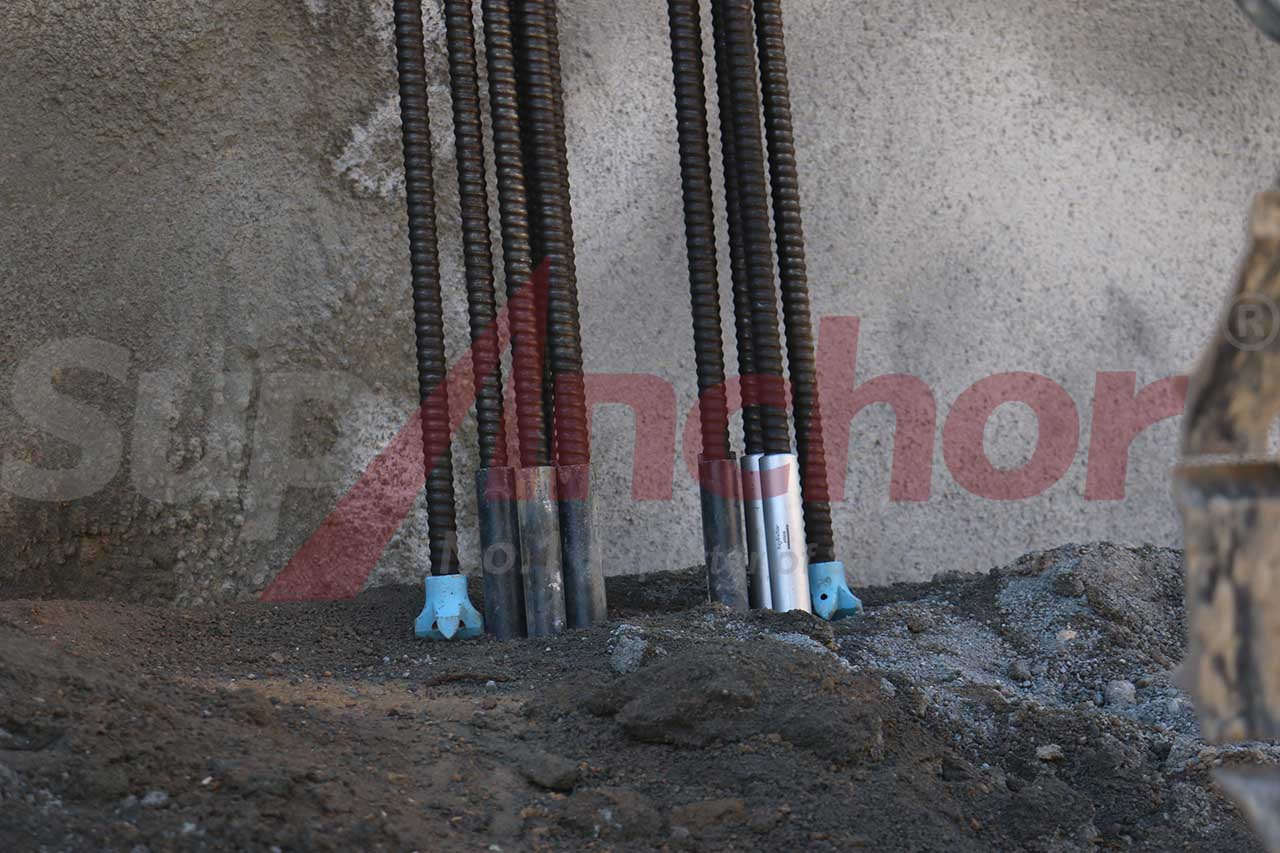
At the tunnel face, crews mobilized a fleet of multi-boom drilling jumbos equipped with hollow bar anchors from SupAnchor. The image captured during construction shows a typical installation: a self drilling anchor bolt being rotated into the face with cementitious grout pumped through the central bore, creating an immediate bond with the rock matrix. This drill-and-grout bolt technique proved critical in zones where the rock mass rating (RMR) dropped below 35, as it prevented hole collapse and maintained drill alignment even in heavily fractured, water-dripping sections.
The primary anchor used was the SDA R32N model, a hollow bar anchor manufactured from high-tensile alloy steel with a minimum yield strength of 500 MPa and ultimate tensile strength exceeding 650 MPa. Following the manufacturer’s technical guidance, each anchor was installed to a standard bond length of 4.0 m, with a total bar length of 6.0 m and an outer diameter of 32 mm. The continuous M-thread profile along the full length allowed for post-grouting tensioning using standard hex nuts and bearing plates, enabling the system to act as both a temporary spile support and a permanent ground reinforcement element.
Corrosion protection was a key design consideration given the aggressive groundwater chemistry (pH 5.5–6.0 and moderate sulfate content). SupAnchor supplied anchors with double corrosion protection consisting of a hot-dip galvanized internal surface and an external polyethylene shrink sleeve over the free-stressing length. This durable coating system, combined with the dense cement grout cover of at least 20 mm, ensures a service life exceeding 50 years in Class II exposure conditions as defined by EN 14490.
To monitor anchor performance, the site team instrumented 10% of the installed hollow bar anchors with load cells and tell-tale extensometers. Over the first 12 months of service, the recorded load remained within 15% of the lock-off load of 100 kN, confirming the long-term reliability of the geotechnical reinforcement system. These results align with international guidelines for NATM/SEM tunneling and provide confidence that the temporary construction support transitions into a permanent structural role without excessive deformation.
The successful application of a self drilling anchor for retaining walls and tunnel support on this project underscores a global trend toward faster, safer, and more adaptable ground stabilization methods. According to the International Tunneling Association (ITA), over 60% of tunnel construction cost overruns stem from unforeseen ground conditions. Self drilling anchor systems mitigate this risk by enabling real-time adaptation: if the drill encounters a void or a soft zone, the operator can increase grout flow or adjust the advance rate without withdrawing the steel, drastically reducing stand-up time.
Engineers familiar with soil nail systems and rock bolts increasingly recognize the advantages of a micropile hollow bar anchor that consolidates several steps into one. Unlike conventional rock bolts, which require a pre-drilled hole maintained with a casing, the hollow bar anchor flushes cuttings through a disposable drill bit and simultaneously fills the annulus with grout under pressure. This method not only speeds the installation cycle by up to 40% but also improves the bond strength by pressurizing the grout into the fissures, enhancing the ground’s intrinsic strength through permeation grouting.
Beyond tunneling, the same technology is widely adopted in slope stabilization, deep excavations, and underground mining. In open-pit mines, a rock bolt for underground mining applications serves both as immediate support for development headings and as a long-term ground reinforcement element in stopes. The ability to install a high-capacity soil nail system without a casing makes it particularly suited for retaining wall construction in urban environments, where vibration and noise constraints limit the use of percussion drilling. SupAnchor’s ground anchor bolt factory precisely manufactures each bar to order, enabling a direct supply model that reduces cost and lead time for large-scale infrastructure programs.
Behind every installed anchor lies a rigorous quality assurance process. SupAnchor operates an ISO 9001-certified SDA bolt factory equipped with automated rolling lines and robotic welding cells. Every batch undergoes mechanical testing, including tensile strength, elongation, and thread integrity, as well as dimensional checks against ASTM and EN standards. The company’s laboratory also performs salt-spray corrosion tests that simulate 2,000 hours of accelerated exposure, verifying the durability claims of their corrosion protection systems.
The firm has contributed to iconic projects across Europe, North America, and Asia, supplying self drilling anchors for high-speed rail tunnels, hydroelectric powerhouse caverns, and coastal retaining structures. In one recent case, an anchor bolt system for geotechnical engineering provided the sole support for a 15 m high vertical cut in densely jointed granite, allowing construction of an underground metro station directly beneath a historic city center.
“We view each project as a partnership,” said a senior geotechnical engineer at SupAnchor. “Our self drilling bolt for civil engineering is not merely a product; it’s an integrated solution that starts with design consultation, continues with on-site testing, and extends through post-installation monitoring.” This consultative approach aligns with the “Professional, Innovative, Collaborative” ethos that shapes the company’s long-term relationships with contractors and consultants.
| Parameter | Specification | Remarks |
|---|---|---|
| Bar Diameter | 32 mm | R32N hollow bar |
| Tensile Yield Strength | ≥500 MPa | Tested per ISO 6892-1 |
| Ultimate Tensile Strength | ≥650 MPa | Ensures ductile failure mode |
| Bond Length | 4.0 m (typical) | Adjusted per ground conditions |
| Corrosion Protection | Double protection: HDG + PE sleeve | Service life >50 years |
As global spending on transportation infrastructure is projected to reach $4.5 trillion annually by 2030, demand for efficient geotechnical reinforcement systems will continue to grow. Self drilling anchor technology reduces both the carbon footprint and the construction program of ground support tasks. By replacing conventional temporary methods—which often require duplicate works for permanent support—a hollow bar anchor system eliminates waste and speeds the completion of vital road, rail, and water tunnels.
The lessons learned from this highway tunnel will be shared across the engineering community through technical papers and workshops, fostering wider adoption of drill-and-grout bolts in other challenging settings. For contractors seeking a soil nail system manufacturer with a proven track record, the performance data collected here serves as a strong testament. Meanwhile, SupAnchor is investing in R&D to develop even higher-strength steel alloys and biodegradable grouts, aiming to further reduce the environmental impact of ground stabilization anchor systems.
In an era where resilience and speed are equally critical, the humble self drilling anchor bolt stands out as a key enabler of safe, economical, and durable infrastructure. The mountain may be stubborn, but with the right tools and expertise, engineers continue to find a path through—one anchor at a time.
SupAnchor's self drilling anchor system played a pivotal role in stabilizing steep slopes during a major highway expansion in the Alps, demonstrating advanced geotechnical reinforcement capabilities.
SupAnchor introduces the SupFRP GFRP Tie Rod, a corrosion-resistant, non-removable formwork solution that cuts costs and improves safety. Learn about its technical advantages and global impact.
SupAnchor's self drilling anchor system plays a critical role in a challenging European infrastructure project, providing efficient ground stabilization and geotechnical reinforcement in difficult soil conditions.
SupAnchor introduces the SupHulk PM series friction rock bolts, offering immediate load-bearing capacity and full-column friction support for mining and tunneling applications. The system features high yield loads and adapts to varied rock conditions.
SupAnchor's self drilling anchor system was deployed in a European alpine tunnel project, solving complex geological challenges with a single-pass drill-and-grout solution, highlighting the strength of hollow bar anchors.