
Across Europe and North America, aging concrete infrastructure faces an escalating crisis: corrosion of traditional steel reinforcement leads to cracking, spalling, and costly repairs. In marine environments, bridge decks pounded by de-icing salts, and industrial plants exposed to aggressive chemicals, the search for durable alternatives has become a top priority. SupAnchor, a globally recognized leader in geotechnical reinforcement systems, has responded with the SupFRP® GFRP Reinforcement Rebar—a fiberglass-based solution that promises to redefine longevity in concrete construction.
Developed through years of R&D and validated in demanding field applications, this Glass Fiber Reinforced Polymer (GFRP) rebar is manufactured from high-quality corrosion-resistant resin and fiberglass. It directly tackles the inherent weaknesses of steel, offering a non-metallic, non-corrosive, and high-strength product that meets the most stringent engineering standards. With a portfolio already encompassing self drilling anchor systems, hollow bar anchors, and drill-and-grout bolts for tunneling and ground support, SupAnchor now expands its reach into structural reinforcement, bridging temporary construction needs with permanent structural integrity.
The SupFRP® rebar stands out due to its exceptional mechanical properties and versatility. Designed with a waved thread structure for superior concrete bonding, it is available in diameters from 9 mm (ReB-8) up to 45 mm (ReB-40), with guaranteed tensile loads reaching over 1000 kN in the largest diameters. The table below highlights key specifications for commonly used sizes:
| Model | Nominal Diameter (mm) | Guaranteed Tensile Load (kN) | Tensile Strength (MPa) | E-Modulus (GPa) | Weight (kg/m) |
|---|---|---|---|---|---|
| ReB-10 | 11.5 | 79 | 1000 | 50 | 0.20 |
| ReB-12 | 14 | 113 | 1000 | 50 | 0.28 |
| ReB-16 | 18 | 201 | 1000 | 50 | 0.50 |
| ReB-20 | 23 | 314 | 1000 | 50 | 0.79 |
| ReB-25 | 28 | 491 | 1000 | 50 | 1.20 |
All sizes feature a tensile E-modulus of 50 GPa and an ultimate strain of 2%, ensuring sufficient ductility for structural applications. Notably, the rebar is non-conductive and non-magnetic—critical for sensitive environments such as MRI rooms, electrical substations, or military installations. Its corrosion-proof nature makes it ideal for permanent applications in sea walls, port aprons, and chemical plants, where traditional steel would require expensive coatings or cathodic protection.
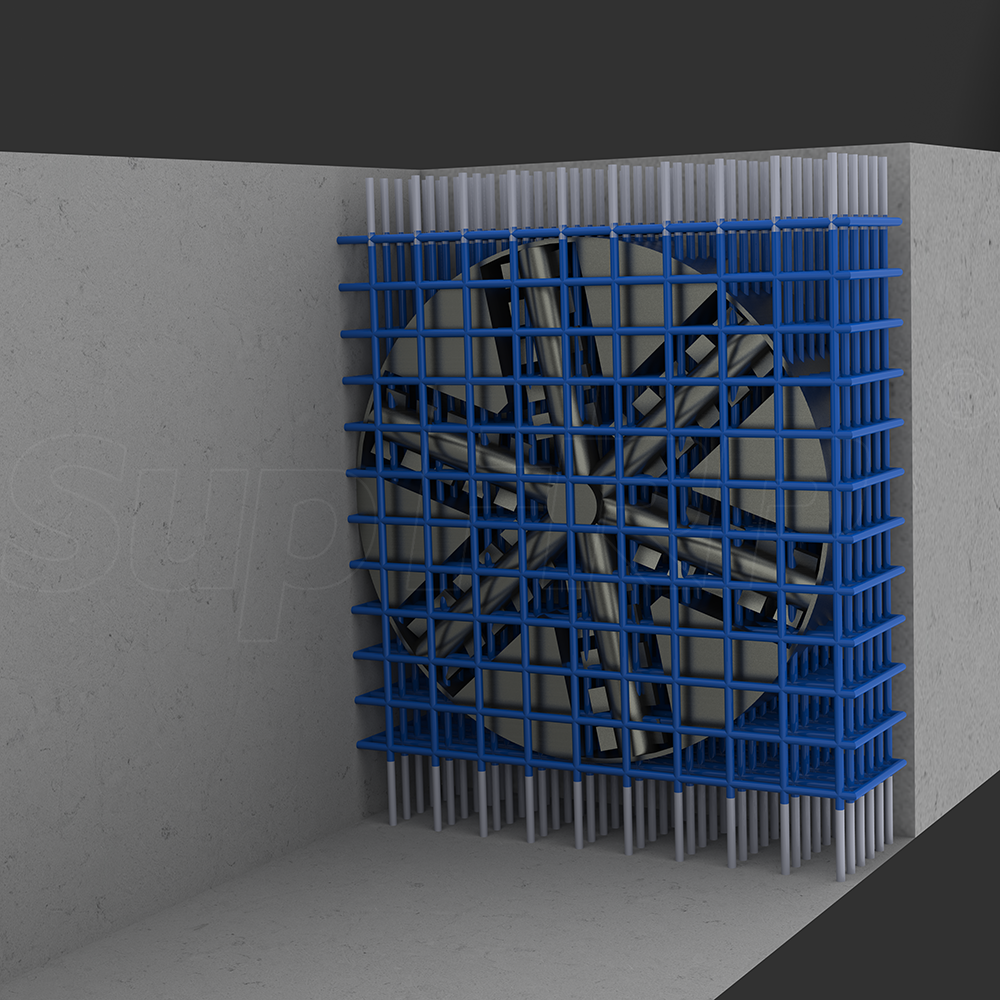
The versatility of GFRP rebar unlocks a wide range of uses. In soft-eye excavations for tunnel boring machines (TBMs), the rebar’s easy cutting and non-magnetic properties allow TBM cutters to pass through the reinforced concrete without damage or spark hazard—a significant advantage over steel. Infrastructure projects like bridge decks and foundations benefit from the rebar’s high tensile strength (up to 1000 MPa for most diameters) and light weight, which reduces handling labor and accelerates construction.
Precast element manufacturers have reported faster production times due to the rebar’s ease of cutting and shaping. Unlike steel, GFRP rebar can be produced in factory-made custom shapes, reducing on-site fabrication errors. Moreover, its low weight—just 0.2 kg/m for ReB-10—translates into lower transportation costs and simpler installation, especially in remote or high-elevation projects where logistics are challenging.
In marine environments, GFRP rebar has proven its worth in sea walls and port aprons exposed to saltwater. Traditional steel rebar in such settings begins to corrode within decades, causing structural failure. SupAnchor’s solution eliminates this lifecycle cost, offering a maintenance-free service life that aligns with 100-year design criteria increasingly demanded by infrastructure owners.
Global infrastructure investment is projected to reach $94 trillion by 2040, with a growing share dedicated to resilient and sustainable construction. GFRP rebar directly addresses this trend by extending structural lifespan and reducing maintenance. It aligns with green building certifications, as its production has a lower carbon footprint than steel and its longer service life reduces resource consumption.
Geotechnical engineers appreciate that SupAnchor offers a complete reinforcement package: from hollow bar anchors and self drilling anchor bolts for ground support to GFRP rebar for final linings. This one-stop-shop approach simplifies procurement and ensures technical compatibility. In mining and tunneling, where convergence monitoring post-installation is critical, the non-magnetic rebar does not interfere with measurement equipment, adding a safety and data quality advantage.
The product’s high corrosion resistance and non-conductivity also make it suitable for industrial plants handling caustic materials or electrical hazards. As a soil nail system manufacturer, SupAnchor has long provided reliable ground anchor solutions; the addition of GFRP rebar allows it to serve contractors needing both temporary excavation support and permanent concrete reinforcement from a single trusted source.
SupAnchor’s global footprint is built on a foundation of continuous innovation and adherence to international standards. The company holds multiple ISO certifications and has supplied anchor systems to iconic projects across Europe, the Americas, Southeast Asia, and the Middle East. Its R&D teams collaborate with universities and construction firms to develop solutions that tackle real-world challenges.
The launch of SupFRP® GFRP Reinforcement Rebar embodies the company’s “Professional, Innovative, Collaborative” philosophy. By combining state-of-the-art manufacturing with deep geotechnical expertise, SupAnchor not only delivers a product but also provides comprehensive technical support, from design consultation to on-site training. This commitment ensures that specifiers and contractors can confidently adopt new materials, knowing they have a partner dedicated to their project’s success.
As the construction industry embraces performance-based design, advanced materials like GFRP rebar are moving from niche to mainstream. SupAnchor’s entry into this market not only expands its product ecosystem but also reinforces its reputation as a forward-looking, adaptable supplier. Whether for a deep foundation in corrosive soil or a bridge deck in a harsh winter climate, the SupFRP® rebar delivers on the promise of strength without compromise, durability without maintenance, and innovation that builds the future.
SupAnchor's self drilling anchor system provides efficient ground stabilization in challenging geology, with high-strength hollow bar anchors and corrosion protection for civil engineering projects.
SupAnchor introduces a corrosion-resistant GFRP solid bolt with high tensile strength, lightweight design, and non-conductive properties for slope stabilization, tunnel support, and mining applications.
A European transport project uses SupAnchor's self drilling anchor system to stabilize loose overburden and fractured rock. Hollow bar anchors provide immediate load capacity, corrosion protection, and long-term geotechnical safety.
SupAnchor introduces SupFRP® GFRP reinforcement rebar with high tensile strength, corrosion resistance, and versatile shapes for demanding construction applications across Europe and North America.
SupAnchor introduces a stainless steel self-drilling hollow anchor combining 3-in-1 drilling, grouting, and reinforcing with superior corrosion resistance for marine, chemical, and permanent geotechnical applications.