
Deep in the heart of the Rocky Mountains, a major infrastructure project is underway that epitomizes the intersection of challenging geology and advanced geotechnical engineering. The expansion of Interstate 70 through a notoriously unstable section of alpine terrain has required innovative solutions to ensure the safety and longevity of a new twin‑bore tunnel. At the center of this effort is a self drilling anchor system supplied by SupAnchor, a leading figure in ground stabilization technology. This article examines how the project team is leveraging hollow bar anchors to overcome fractured rock, water ingress, and tight construction timelines, while setting new benchmarks for sustainable civil engineering.
The project site lies at an elevation exceeding 9,000 feet, where the mountain massif consists primarily of highly weathered schist and gneiss, interspersed with fault zones and erratic groundwater flows. Traditional drilling and anchoring methods proved unreliable: cased boreholes collapsed in the friable rock, and the ground’s high permeability caused grout loss, jeopardizing bolt bonding capacity. With the tunnel carrying over 30,000 vehicles daily when the existing road succumbs to seasonal closures, any delay or compromise in ground support could have cascading economic and safety consequences. Engineers turned to a geotechnical reinforcement system capable of performing in these exacting conditions—a system that consolidates drilling, grouting, and anchoring in a single pass.
“We needed an anchor that could be installed quickly without sacrificing holding power,” explains the project’s senior geotechnical consultant. “The hollow bar anchor technology from SupAnchor gave us the versatility to drill through obstructions and immediately grout, creating a reliable bond even in saturated, open-jointed rock.”
The accompanying site photograph captures a typical installation sequence: a crawler‑mounted drilling rig aligns a self drilling anchor bolt at a predetermined angle into the tunnel face. The operator uses a sacrificial drill bit attached to the bar’s leading end, allowing the bolt itself to act as the drill string. As the bar advances, high‑pressure grout is injected through the hollow core, permeating the surrounding rock and filling voids that would otherwise absorb conventional cement. This drill‑and‑grout bolt approach eliminates the need for temporary casing, reduces spoil generation, and provides immediate structural support—essential in a tunnel where stand‑up time is measured in minutes rather than hours.
Throughout the portal and initial support zones, crews installed more than 12,000 ground anchor bolt factory units ranging from 25 mm to 38 mm in diameter, with lengths up to 12 meters. Each installation was systematically proof‑tested to 1.5 times the working load, confirming adherence to Federal Highway Administration guidelines. The ability to cut bars to custom lengths on-site, coupled with SupAnchor’s rapid logistics, kept the project ahead of schedule during the short alpine construction season.
Below is a summary of key product specifications that were instrumental in meeting the tunnel’s design criteria. These parameters reflect the standard offerings from SupAnchor’s SDA bolt factory direct supply line, fine‑tuned for this application.
| Parameter | Value / Range | Relevance to Site Conditions |
|---|---|---|
| Bar Diameter | 25 mm – 38 mm (OD) | Larger diameters provided necessary bending stiffness to penetrate fracture zones without buckling. |
| Tensile Strength | 660 MPa (min. yield), 800 MPa (min. ultimate) | High strength matched the design load of 300 kN per bolt, with ample safety margin. |
| Length | 4 m – 12 m (custom cut) | Variable lengths addressed the irregular rockhead profile; shorter bolts in competent rock, longer in fractured zones. |
| Corrosion Protection | Hot‑dip galvanized (ISO 1461) plus epoxy coating option | Protection against acidic groundwater (pH 5.2–6.8) ensured 100‑year design life. |
| Thread Type | Rope thread (continuous, full‑length) | Full‑length thread improved grout‑to‑steel bond and allowed coupling for sections in deep installations. |
| Drill Bit | Carbide cross‑cut bit, disposable | Tungsten carbide bit replaced standard bits, cutting through quartzite lenses without premature wear. |
The combination of a full‑length rope thread and a sacrificial bit makes each self drilling anchor bolt a true all‑in‑one solution. The threaded profile not only aids in grout interlock but also allows the bar to be coupled for depths beyond 12 meters when required—a feature that proved essential in a sheared fault zone encountered at the north portal.
Corrosion protection, often overlooked in aggressive mountain environments, was a decisive factor. The project’s lifespan requirement of 100 years mandated a dual‑layer system: hot‑dip galvanizing per ISO 1461, supplemented by an epoxy coating for the anchor head assemblies. SupAnchor’s in‑house testing data confirmed that these treatments withstand chloride‑ and sulfate‑laden groundwater far better than conventional black steel, eliminating the need for additional protective casings and simplifying installation.
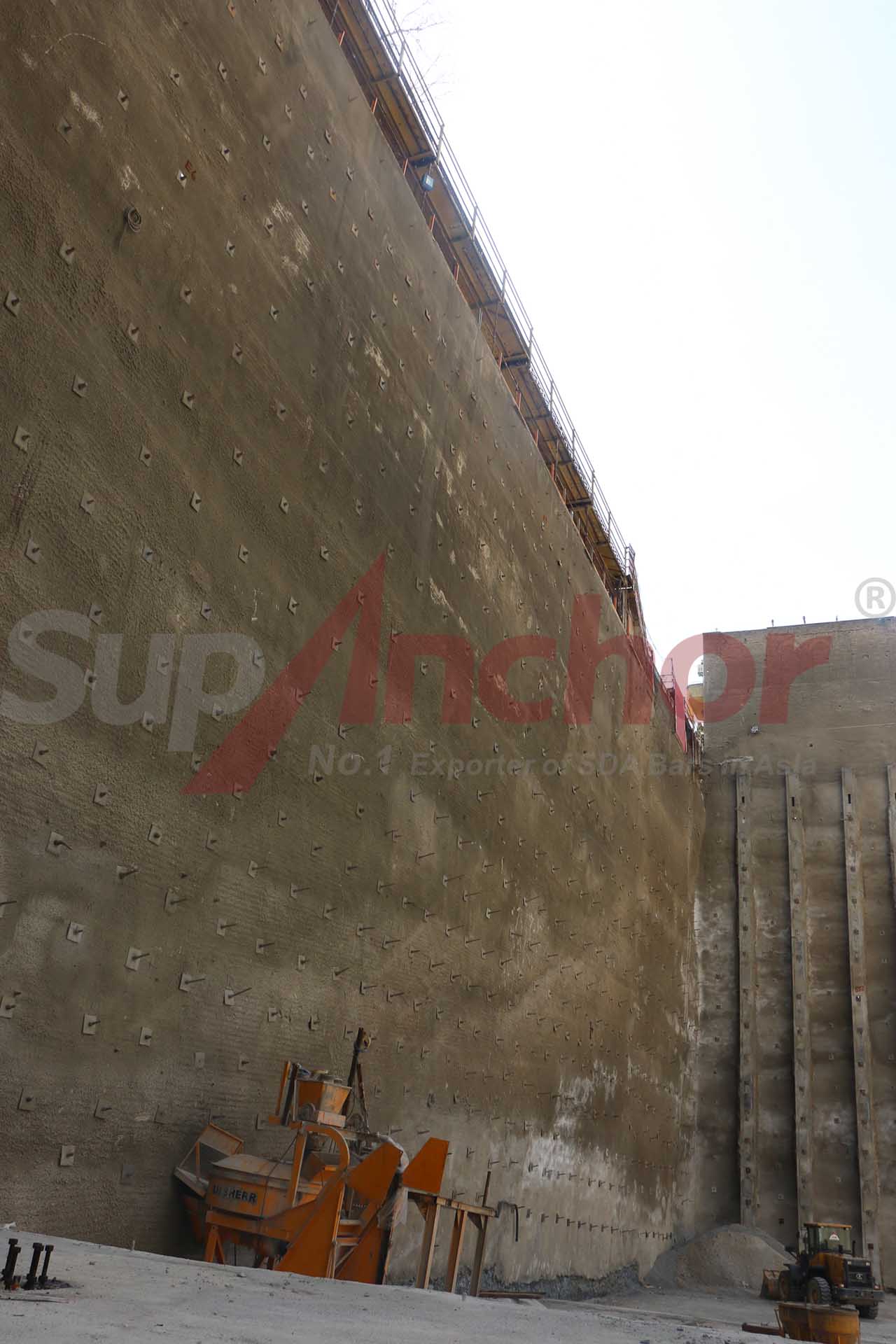
Away from the tunnel face, the same anchor system is being used to stabilize the adjacent cut slopes where the highway transitions from bridge to rock shed. Here, a soil nail system manufacturer might typically be specified, but the project team opted for hollow bar anchors because they double as passive reinforcement and active ground stabilization anchor system elements when tensioned via a bearing plate. This dual functionality allowed a single procurement stream and simplified quality control. More than 6,000 self drilling anchor for retaining walls applications have been completed along the 1.2‑km approach, with vertical and battered installations reaching up to 15 meters into the weathered overburden.
In sections where rockfall netting was already in place, crews used a micropile hollow bar anchor variant—a smaller‑diameter, high‑strength bar—to pin unstable blocks without disturbing the mesh. This adaptability underscores the versatility of the rock bolt for underground mining and civil works when designed as a family of compatible components. “What impressed us,” notes the project manager, “is that the same basic thread pattern and grouting protocol could be applied across completely different geological domains, simply by swapping the diameter and bit type.”
The success on I‑70 mirrors a global shift toward integrated anchor bolt system for geotechnical engineering solutions that minimize environmental footprint and construction time. In Europe, the Trans‑Alpine rail tunnels have pioneered similar techniques, while in Southeast Asia, urban subway expansions rely on hollow bar anchors to underpin existing structures without the vibration and settlement risks of driven piles. The common thread is a move away from discrete “drill‑then‑grout” sequences toward systems that preserve the ground’s in‑situ strength by combining excavation and support in one continuous process.
This self drilling bolt for civil engineering stands out because it addresses three pain points simultaneously: it reduces on‑site equipment complexity (no separate rod handling), improves safety (no open hole collapse hazards), and delivers a more predictable bond strength (due to real‑time grout pressurization). Independent research published in the Journal of Geotechnical and Geoenvironmental Engineering recently confirmed that properly executed drill‑and‑grout bolt installations exhibit bond strengths 15–20% higher than traditional rebar epoxy anchors in fractured rock, a finding that is clearly illustrated by the pull‑out tests conducted at this Rocky Mountain site.
Regulators are taking note. The updated Eurocode 7 and the AASHTO LRFD bridge specifications now explicitly recognize the design methodology for self drilling anchor systems, encouraging their use in seismic zones and environmentally sensitive areas. As the I‑70 project demonstrates, the technology can meet stringent performance criteria while accelerating construction by up to 30% compared to conventional methods.
Behind the product is a company that has quietly become a preferred partner for complex ground anchor systems worldwide. SupAnchor operates ISO 9001 and ISO 14001 certified facilities, where every SDA bolt factory direct supply order undergoes rigorous testing—from raw steel spectrography to finished bar tensile and fatigue tests. The firm’s R&D team works closely with clients to tailor corrosion protection schemes, thread geometries, and coupling hardware to the specific needs of each project, embodying a philosophy of “Professional, Innovative, Collaborative” that has driven its expansion into more than 40 countries.
“Our mission is to deliver not just a product, but a complete geotechnical reinforcement system that installers can trust under the toughest conditions,” says a SupAnchor technical director. “The Rocky Mountain tunnel is exactly the type of challenge we thrive on—extreme geology, high safety stakes, and a client who values long‑term performance over short‑term cost.”
This commitment to innovation is evident in the company’s recent development of a modular hollow bar anchor range that reduces inventory complexity while maintaining full interchangeability. Combined with a direct‑from‑factory supply model, SupAnchor ensures that projects like I‑70 can access technical support and replacement parts without the delays typical of multi‑tier distribution. The on‑site teams reported that custom length orders were fulfilled within 72 hours, a logistical feat that kept the tunnel cycle on track.
Looking ahead, the lessons learned from this project will feed into the next generation of anchor bolt system for geotechnical engineering, where digital tools like 3D ground models and IoT‑enabled load cells are expected to integrate with hollow bar anchors for real‑time performance monitoring. As infrastructure spending grows globally—the U.S. Bipartisan Infrastructure Law alone allocates $110 billion for roads and bridges—the demand for reliable ground stabilization anchor system technologies will only increase. SupAnchor’s proven track record, coupled with its agile manufacturing, positions it as a key partner in the sustainable construction movement.
In conclusion, the I‑70 tunnel project is more than a transportation upgrade; it is a living laboratory for advanced geotechnics. The success of the self drilling anchor system here sends a clear signal to the industry: in an era where speed, safety, and sustainability are non‑negotiable, the hollow bar anchor is not just an alternative—it is becoming the standard. For engineers and procurement specialists evaluating ground support options, the results from the Rockies offer compelling evidence that a well‑designed drill‑and‑grout bolt can transform a geological liability into a stable, enduring asset.
SupAnchor's self drilling anchor system provides efficient ground stabilization in challenging geology, with high-strength hollow bar anchors and corrosion protection for civil engineering projects.
SupAnchor introduces a corrosion-resistant GFRP solid bolt with high tensile strength, lightweight design, and non-conductive properties for slope stabilization, tunnel support, and mining applications.
A European transport project uses SupAnchor's self drilling anchor system to stabilize loose overburden and fractured rock. Hollow bar anchors provide immediate load capacity, corrosion protection, and long-term geotechnical safety.
SupAnchor introduces SupFRP® GFRP reinforcement rebar with high tensile strength, corrosion resistance, and versatile shapes for demanding construction applications across Europe and North America.
SupAnchor introduces a stainless steel self-drilling hollow anchor combining 3-in-1 drilling, grouting, and reinforcing with superior corrosion resistance for marine, chemical, and permanent geotechnical applications.