
A landmark infrastructure project in the heart of Europe’s mountainous terrain recently showcased the critical role of advanced ground stabilization techniques. The expansion of a key transportation tunnel – a vital artery for regional commerce – confronted engineers with fractured rock formations, high groundwater pressure, and limited overhead clearance. To overcome these geotechnical hurdles, the project team turned to a proven self drilling anchor system developed by SupAnchor, a leading ground anchor bolt factory with a global track record. The system not only expedited the construction timeline but also ensured long-term stability in one of the most demanding geological settings on the continent.
The tunnel, a 2.8-kilometer twin-bore motorway passage running through the Alpine foothills, was originally built in the 1970s. With traffic volumes doubling over the past two decades, the need for a wider and safer alignment became urgent. However, the geology along the new route alternated between heavily weathered shale and limestone pockets, with a water table sitting barely three meters above the crown. Conventional rock bolts and soil nails proved inadequate – either because of hole collapse during drilling or due to insufficient bond strength in the water-charged fissures. It was against this backdrop that the consulting geotechnical engineer specified a self drilling bolt for civil engineering, one capable of simultaneous drilling, grouting, and anchoring without the need for a temporary casing. SupAnchor’s system, built around its patented hollow bar anchor, emerged as the solution.
The tunnel expansion project forms part of a €420 million investment by the regional government aimed at upgrading the trans-European transport network (TEN‑T). The new alignment required widening the existing cross-section from 9 meters to 13 meters, while maintaining two lanes of traffic throughout construction. The most critical stage was the underpassing of a historic viaduct whose foundations stood only 8 meters above the tunnel crown. Any ground movement exceeding 5 millimeters could have caused irreparable damage to the structure.
Borehole investigations revealed a highly heterogeneous rock mass with unconfined compressive strengths ranging from 15 to 80 MPa, interspersed with clay-filled joints. Water inflows of up to 40 liters per minute were recorded during exploratory drilling, making the ground susceptible to piping and erosion. A conventional rock bolt system would have required either pre-drilling with casing and separate grouting – a slow, two-step process – or a soil nail system manufacturer approach using sacrificial drill bits. Neither option provided the combination of immediate load-bearing capacity and resistance to corrosion demanded by the 120-year design life of the tunnel.
It became clear that a geotechnical reinforcement system based on drill-and-grout bolts was essential. After a thorough technical review, the contractor selected SupAnchor’s SDA (Self Drilling Anchor) series, a range of hollow bar anchors that double as the drill rod, injection pipe, and tension member. The choice was driven by three key factors: the ability to advance through mixed ground without hole collapse, the controlled pressure grouting that improves the rock mass, and the integrated corrosion protection that meets the Eurocode 7 durability requirements.
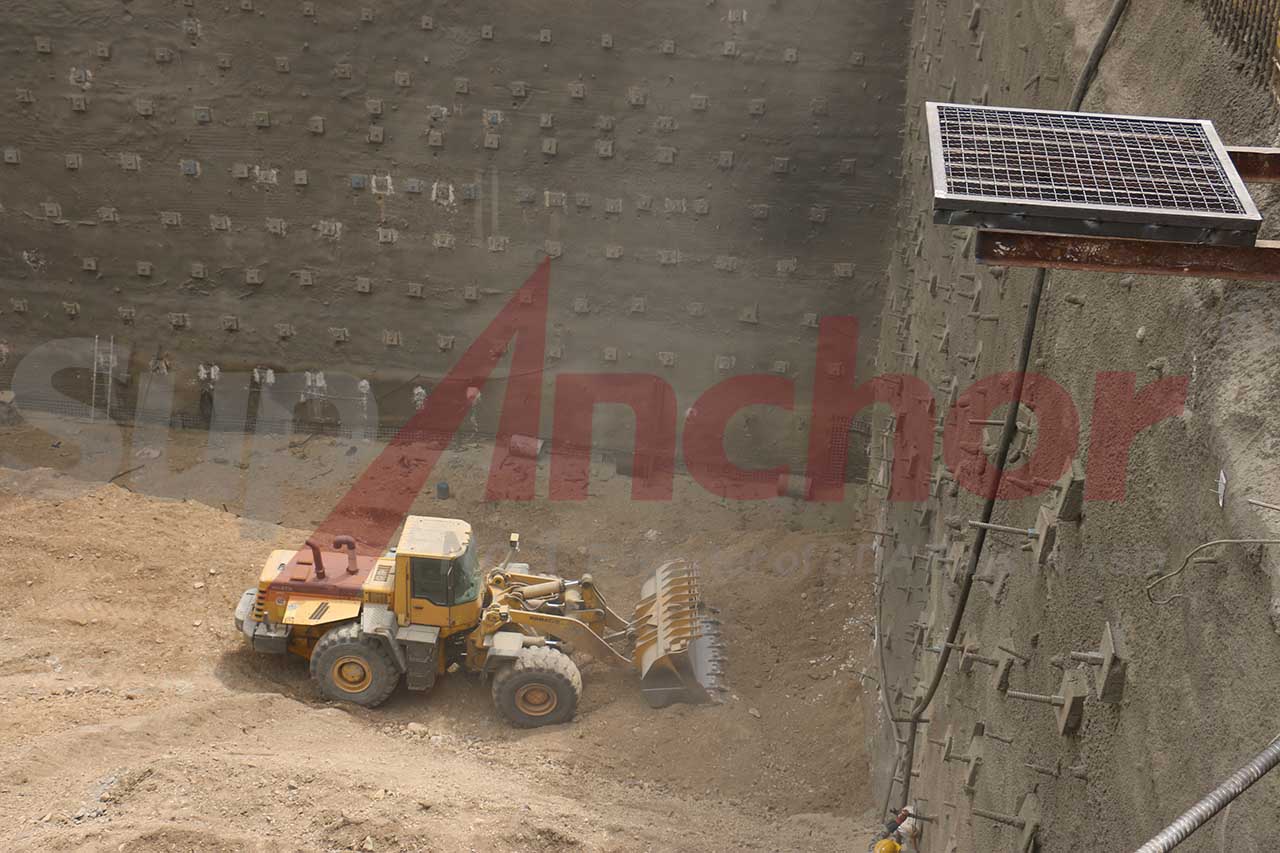
On site, the self drilling anchor system was deployed in various lengths and configurations, depending on the rock mass classification. The primary support consisted of a systematic umbrella of micropile hollow bar anchors installed at the tunnel face before each excavation round. These elements, 9 metres long with a 32 mm outer diameter, created a pre-reinforced canopy that allowed safe advance under the sensitive viaduct. For the radial anchoring of the walls and crown, 6-metre and 9-metre self drilling anchor bolts were used at 1.5 metre longitudinal spacing, often supplemented with steel arches and shotcrete.
The table below summarises the key technical parameters of the SupAnchor SDA‑32 hollow bar that proved critical to the project’s success:
| Parameter | Specification |
|---|---|
| Outer diameter | 32 mm |
| Inner diameter | 19 mm |
| Steel grade / yield strength | G105 / 520 MPa |
| Ultimate tensile strength | 690 MPa |
| Elongation at failure | ≥ 15% |
| Corrosion protection | Hot‑dip galvanised to ISO 1461, plus sacrificial layer where specified |
| Thread type | Left‑hand rope thread, continuous along full length |
| Coupler system | Integral coupler with same outer diameter, capable of resisting full tensile load |
| Drill bit | Tungsten carbide cross‑cut or ballistic‑type, sacrificial |
The installation cycle followed a streamlined, single‑pass process. A hydraulic rotary‑percussive drilling rig, equipped with an adapter for the hollow bar, drove the self drilling anchor bolt into the ground while simultaneously pumping cement grout through the hollow core. The grout, with a water‑cement ratio of 0.4–0.5, exited through the drill bit and filled the annular space, compacting the surrounding ground and forming a permanent bond. Because drilling and grouting occur concurrently, the method eliminates the risk of hole collapse – a crucial advantage in the fractured, water‑bearing rock encountered on this project.
Another significant benefit of the drill-and-grout bolt technology is the immediate load‑transfer capability. Once the grout had set for approximately four hours, the anchors were connected to steel bearing plates and tensioned to 60% of their yield load using a torque‑controlled wrench. This prestressing helped lock loose blocks in place and minimised relaxation of the ground. The full‑length thread of the hollow bar allowed for easy coupling and cutting on site, reducing material waste and installation time. In total, over 8,000 linear metres of SDA‑32 were installed for the pre‑reinforcement canopy alone, and a further 12,000 metres were used for radial support.
The successful application of this ground stabilization anchor system on a European TEN‑T corridor sends a strong signal about the maturity and reliability of self drilling anchor technology. As governments across the world invest heavily in upgrading ageing infrastructure – from road tunnels in the Alps to light‑rail bored drives in North American cities – demand for adaptable, fast‑cycle anchoring solutions is surging. The self drilling anchor for retaining walls, slope protection schemes, and underground excavations is increasingly seen not as a niche product but as a standard first‑choice solution in challenging ground.
In the mining sector, a rock bolt for underground mining must provide not only high tensile capacity but also resistance to dynamic loads and corrosion in aggressive environments. SupAnchor’s hollow bar system, with its continuous thread and hot‑dip galvanised finish, is rapidly gaining acceptance as a primary rock support element in deep, seismically active mines. Likewise, in urban civil engineering, the ability to install a micropile hollow bar anchor from confined spaces – such as inside a tunnel or behind an existing wall – opens up possibilities for underpinning and foundation retrofits that were previously too disruptive to execute.
Supplier reputation also plays a pivotal role in large‑scale public works. SupAnchor operates as an SDA bolt factory direct supply provider, ensuring not only consistent quality but also the flexibility to deliver custom lengths and accessory packages on short notice. The company holds ISO 9001:2015, ISO 14001:2015, and ISO 45001:2018 certifications, and its products meet or exceed the requirements of EN 14490, ASTM A615, and other international standards. This commitment to quality provides owners and designers with the confidence that each self drilling anchor system is produced under rigorous process control.
What truly sets SupAnchor apart, however, is its collaborative engineering approach. From the earliest feasibility stage of the tunnel project, the company’s technical team worked alongside the main contractor and the designer to optimise the anchor bolt system for geotechnical engineering. Finite‑element models were refined using actual pull‑out test data, and the grout mix design was adjusted to achieve the desired set time at the ambient temperature of the tunnel. This kind of thorough, “Professional, Innovative, Collaborative” mindset – the words SupAnchor lives by – ensures that the hollow bar anchor is not simply delivered to the site but is fully integrated into the project’s stability concept.
Looking ahead, the company is investing in next‑generation self drilling bolt for civil engineering, including sensors embedded in the hollow core to allow real‑time monitoring of strain and corrosion. Such innovations will further strengthen the role of the geotechnical reinforcement system in achieving the sustainability and resilience targets of the construction industry. With proven performance in one of Europe’s most demanding tunnel expansions, SupAnchor’s self drilling anchor system remains a benchmark for ground stabilisation – today and for the infrastructure of tomorrow.
SupAnchor's self drilling anchor system provides efficient ground stabilization in challenging geology, with high-strength hollow bar anchors and corrosion protection for civil engineering projects.
SupAnchor introduces a corrosion-resistant GFRP solid bolt with high tensile strength, lightweight design, and non-conductive properties for slope stabilization, tunnel support, and mining applications.
A European transport project uses SupAnchor's self drilling anchor system to stabilize loose overburden and fractured rock. Hollow bar anchors provide immediate load capacity, corrosion protection, and long-term geotechnical safety.
SupAnchor introduces SupFRP® GFRP reinforcement rebar with high tensile strength, corrosion resistance, and versatile shapes for demanding construction applications across Europe and North America.
SupAnchor introduces a stainless steel self-drilling hollow anchor combining 3-in-1 drilling, grouting, and reinforcing with superior corrosion resistance for marine, chemical, and permanent geotechnical applications.