
Across the globe, infrastructure networks face relentless demands from heavy traffic, temperature swings, and environmental exposure. At the heart of durable concrete pavements lies a critical detail: the construction joint. Without reliable load transfer, slabs crack, fault, and degrade prematurely. SupAnchor, a leader in advanced reinforcement systems, has met this challenge with its new SupFRP® GFRP Dowel Bar—a product engineered to preserve structural integrity for well over a century.
Unlike traditional steel dowels, the glass‑fiber‑reinforced polymer (GFRP) dowel bar eliminates corrosion entirely, ensuring that joints remain functional even in aggressive environments. This breakthrough is already drawing attention from civil engineers and contractors who prioritize lifecycle cost and reliability.
The SupAnchor GFRP dowel bar is manufactured from premium raw materials using a pultrusion process that aligns continuous glass fibers within a high‑performance resin matrix. The result is a bar with exceptional mechanical properties and chemical resistance. Key benefits include:
These characteristics position the GFRP dowel bar as a versatile solution for modern construction challenges.
The SupFRP® GFRP Dowel Bar is available in six standard diameters, each meticulously engineered to deliver predictable shear capacity and thermal compatibility. Their coefficient of thermal expansion (9‑11×10⁻⁶/°C) closely matches that of concrete, minimising internal stresses during temperature cycles.
| Model | Outer Diameter (mm) | Transverse Shear Load (kN) | Cross Sectional Area (mm²) | Weight (kg/m) |
|---|---|---|---|---|
| DB16 | 16 | 35 | 200 | 0.43 |
| DB20 | 20 | 55 | 310 | 0.67 |
| DB25 | 25 | 85 | 490 | 1.05 |
| DB32 | 32 | 130 | 800 | 1.71 |
| DB38 | 38 | 180 | 1130 | 2.41 |
| DB45 | 45 | 255 | 1590 | 3.37 |
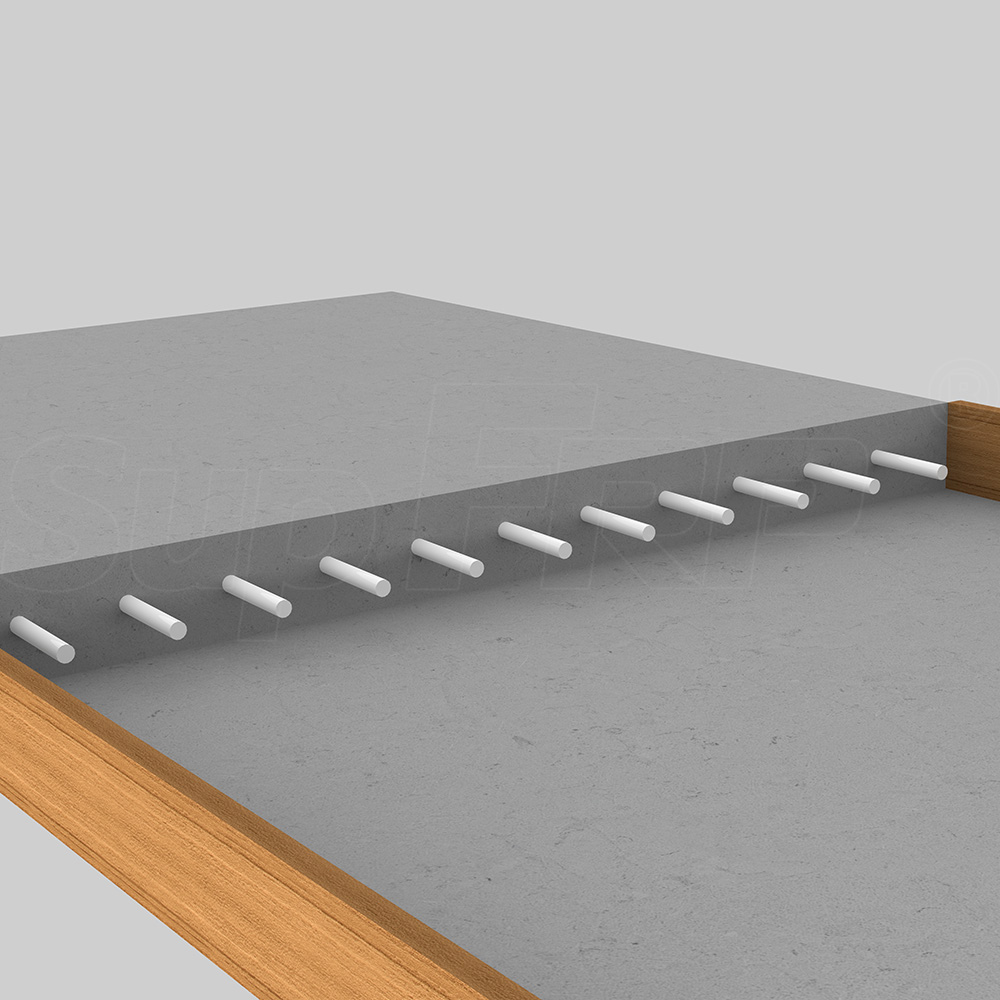
Custom diameters and lengths are also available, allowing engineers to tailor the bar to specific project requirements. Whether for highway joints, airport runways, or industrial floors, the product family covers a broad performance envelope.
The SupAnchor GFRP dowel bar excels in:
As nations invest in climate‑resilient infrastructure, the 100‑year design life of GFRP dowels directly lowers maintenance costs and traffic disruptions. In Europe and North America, several highway agencies are already revising standards to allow GFRP dowels as a sustainable alternative to epoxy‑coated or stainless steel bars. The environmental benefit is clear: fewer replacements mean less raw material extraction, reduced carbon footprint, and less waste over the asset’s lifetime.
SupAnchor has built its reputation on deep R&D investment, rigorous quality control, and a collaborative approach with contractors and designers. The company holds ISO 9001, ISO 14001, and OHSAS 18001 certifications, and its products have been deployed in landmark projects across Asia, Europe, and the Americas. From high‑speed rail tunnels to deep foundation pits, SupAnchor’s ground reinforcement systems consistently perform under extreme conditions.
The SupFRP® GFRP Dowel Bar exemplifies the brand’s philosophy: Professional, Innovative, Collaborative. By combining advanced composite technology with real‑world engineering insight, SupAnchor delivers a product that not only solves today’s load‑transfer puzzle but also anticipates the long‑term needs of global infrastructure. As project owners and consultants demand greater durability and lower lifecycle costs, the GFRP dowel bar stands ready to become the new benchmark for concrete joint design.
A European highway project overcame fractured rock and groundwater challenges using SupAnchor's self drilling anchor system. The hollow bar anchors provided rapid installation and high load capacity, showcasing innovation in geotechnical reinforcement.
SupAnchor introduces the SupFRP® GFRP Friction Bolt, a world-first corrosion-resistant, lightweight, and non-conductive ground support solution for mining and tunneling.
A major mountain highway expansion in the European Alps utilized SupAnchor's self drilling anchor system to overcome fractured rock and loose soil, ensuring long-term slope stability and construction safety.
SupAnchor's Grade 75 self-drilling hollow anchor bars deliver high bond strength, ASTM A615 compliance, and full compatibility with R/T thread systems for demanding geotechnical projects.
A self drilling anchor system from SupAnchor has been deployed in a challenging mountain infrastructure project, overcoming fractured rock and unstable slopes while reducing installation time and improving long-term ground stabilization.