
A large-scale infrastructure development cutting through the foothills of a mountain range has successfully employed a self drilling anchor system supplied by SupAnchor, the project's lead geotechnical contractor reported last week. The project, which includes a 1.8-kilometer cut-and-cover tunnel and a series of deep retaining walls, faced severe ground conditions: heavily fractured metamorphic rock, high groundwater inflow, and steep slope angles exceeding 60 degrees. Conventional drilling and anchor installation methods proved inefficient and risky, prompting the engineering team to adopt SupAnchor's hollow bar anchor technology as the primary geotechnical reinforcement system.
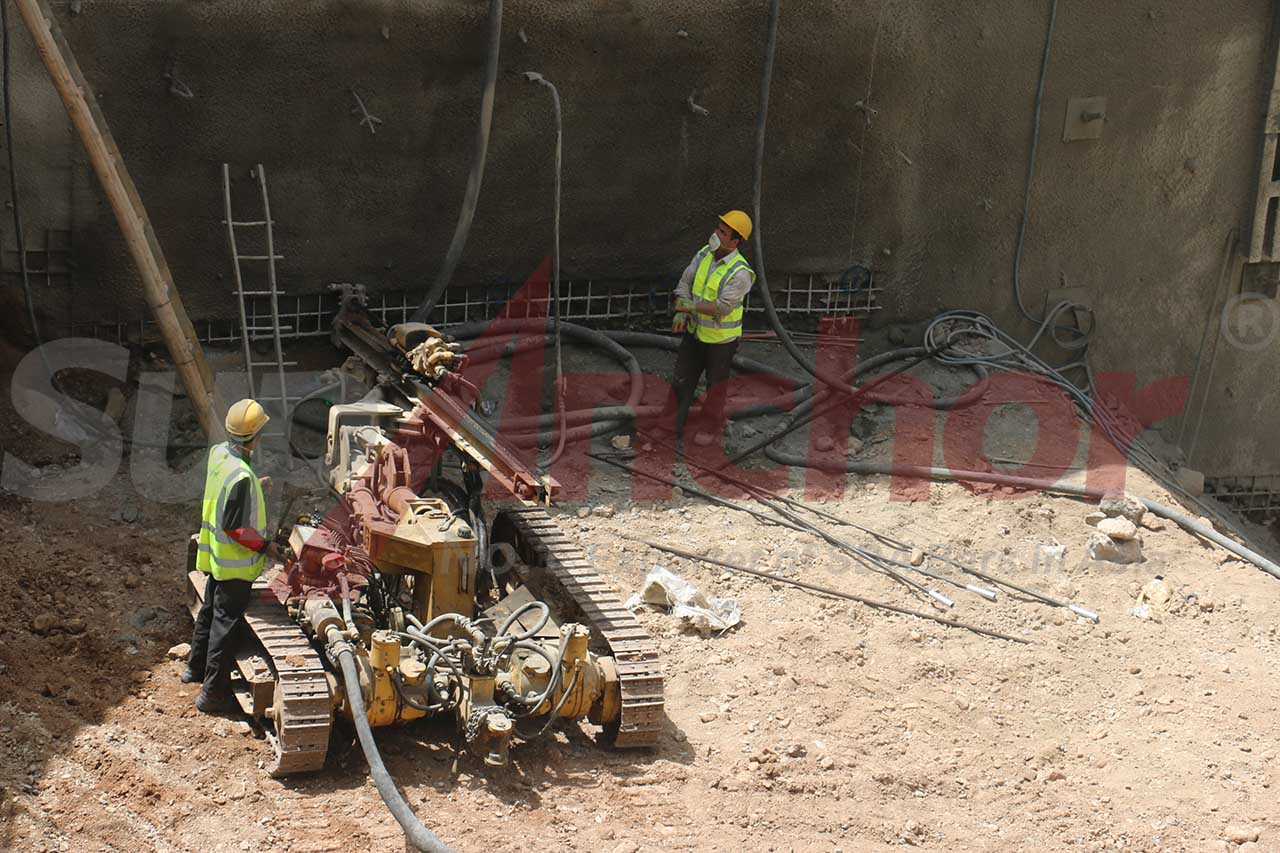
The attached construction site photograph captures a key phase of the installation. A tracked drilling rig equipped with a SupAnchor self drilling anchor bolt is seen boring into a near-vertical rock face, while two site engineers in high-visibility clothing monitor alignment and grout pressure. Dust from the drill head indicates continuous penetration through dense rock. The scene exemplifies the drill-and-grout bolt method, in which a single hollow steel bar simultaneously drills, injects cement grout, and forms a load-bearing anchor—eliminating the need for temporary casing and separate grouting stages.
The total project investment exceeds USD 240 million, with the anchor and retention package accounting for approximately 12% of the geotechnical budget. Completion of the current phase is scheduled for the third quarter of 2026, after which the tunnel will serve as a key link in a regional transportation corridor, reducing travel time by 35 minutes for more than 50,000 daily commuters.
The corridor lies within a geologically complex zone where tectonic activity has created a matrix of faulted gneiss and schist. Borehole samples revealed rock quality designation (RQD) values as low as 25% in the upper 10 meters, with frequent clay-filled joints. Groundwater was encountered at depths of only 3 to 5 meters, creating a risk of borehole collapse during drilling. The original design called for driven soil nails and conventional rock anchors, but early tests showed that pre-drilled holes would collapse before insertion, and water inflow diluted the grout.
Project engineers then turned to SupAnchor, a recognized soil nail system manufacturer and ground anchor bolt factory, for a more robust solution. After site analysis, SupAnchor recommended its R32 and R38 self drilling anchor system, which uses a continuous hollow bar with a sacrificial drill bit. The system allows drilling through unstable ground while simultaneously flushing the hole with air or water and injecting grout under pressure. This approach not only stabilizes the borehole but also enhances the bond between the anchor and surrounding rock.
The project includes more than 4,200 permanent ground anchors installed to depths between 6 and 15 meters. These anchors secure three major retaining walls, stabilize a 120-meter-long slope above the tunnel portal, and provide temporary support for a 22-meter-deep excavation shaft. The use of self drilling anchors for retaining walls proved particularly valuable where access was limited and vibration restrictions applied.
Initial test sections showed that the hollow bar anchor could be installed even in zones with running sand layers and cobbles, which had previously caused drill string jamming. The design load per anchor ranged from 150 kN to 450 kN depending on location, with the higher loads near the tunnel portal where lateral earth pressures were greatest. A total of 276 sacrificial anchors underwent pull-out testing, with all exceeding the 1.5 times design load criterion and an average displacement of less than 8 mm at proof load.
During installation, the SupAnchor hollow bar anchor is rotated and advanced by a top-hammer drilling rig. Grout is pumped through the hollow core at pressures up to 20 bar, filling fissures and creating a reinforced grout column. Once the desired depth is reached, the bar remains in place, and after grout curing, it is tensioned to the design load using a plate and nut assembly. The continuous process reduces installation time by approximately 30 to 40 percent compared to traditional cased boreholes, according to the contractor.
The following table summarizes the key technical parameters of the SupAnchor self drilling anchor bolt used on this project:
| Parameter | Value |
|---|---|
| Nominal outer diameter | 32 mm / 38 mm |
| Ultimate tensile strength | 660 MPa |
| Yield strength | 525 MPa |
| Elongation at break | 8% |
| Standard lengths | 2 m, 3 m, 4 m, 6 m (couplers extend) |
| Corrosion protection | Hot-dip galvanized (optional double corrosion protection) |
The high tensile strength of 660 MPa ensures the anchor can withstand significant rock movement and seismic loads common in mountainous regions. The hollow core design permits efficient grout injection even in water-bearing ground, while the hot-dip galvanized coating provides long-term corrosion resistance, critical for permanent structures with a 75-year design life. Couplers allow extension to any required length, making the system adaptable to variable depths.
Quality control during installation included daily pull-out tests on sacrificial anchors at 1.5 times the design load, all of which exceeded acceptance criteria. The grout mix—using a water-cement ratio of 0.4 and a superplasticizer—achieved a 28-day compressive strength of 35 MPa, ensuring a robust bond between the bar and the rock mass. Real-time monitoring of drill torque and grout pressure allowed the operator to detect voids and adjust pumping rates immediately, reducing the risk of incomplete grouting.
Beyond this project, the same SupAnchor drill-and-grout bolt is used as a micropile hollow bar anchor for foundation underpinning and as a rock bolt for underground mining operations where rapid installation and immediate load capacity are essential. The versatility of the integrated drilling and anchoring approach reduces inventory costs for contractors who can use one product across multiple applications. For example, in a recent urban excavation in Hamburg, Germany, the same R32 system was employed to support a 9-meter-deep basement next to a historic church, with vibration levels measured below 2 mm/s.
The successful application highlights a broader shift in geotechnical engineering toward integrated drilling and anchoring technologies. As global infrastructure spending accelerates—especially in transportation, renewable energy, and urban underground space—engineers increasingly demand ground stabilization anchor systems that can handle difficult ground without extensive site preparation. The self drilling bolt for civil engineering is becoming standard in Europe and North America, where environmental regulations limit vibration, noise, and spoil disposal.
Tunneling projects, slope stabilization, and deep excavations in urban areas benefit from the anchor bolt system for geotechnical engineering because it reduces the number of site operations and enhances worker safety. In the United States, state departments of transportation have approved hollow bar anchors for rock slope repair, while European contractors specify them for railway tunnel refurbishment under live traffic. The method's low vibration profile also suits projects near hospitals, schools, and historic structures.
Mining remains another key market. The rock bolt for underground mining applications, often a SupAnchor self drilling anchor bolt with high elongation, provides immediate support in advancing headings and helps prevent roof falls. Suppliers with SDA bolt factory direct supply capabilities, like SupAnchor, can meet the high-volume demands of mining operators while maintaining consistent quality.
Additionally, the push for sustainable construction favors this integrated drilling and anchoring technology because it generates less spoil, consumes less water than conventional flushing, and reduces the carbon footprint of drilling equipment by shortening cycle times. These advantages are expected to drive adoption further as governments implement stricter environmental standards.
Market analyses project the global ground anchor market to grow at a compound annual rate of 6.2% through 2030, driven by urbanization and aging infrastructure in developed economies. The use of hollow bar anchors in seismic retrofitting is also rising, as they provide ductile behavior under cyclic loading—a key requirement in earthquake-prone regions such as California, Japan, and southern Europe.
SupAnchor has built a reputation as a leading developer and manufacturer of geotechnical anchoring products. The company operates advanced production facilities and holds ISO 9001:2015 for quality management, ISO 14001:2015 for environmental management, and ISO 45001:2018 for occupational health and safety. Its products carry CE marking and are tested according to international standards such as EN 14490 and ASTM A615.
The company's core values—Professional, Innovative, Collaborative—are reflected in its approach to this project. SupAnchor's engineers worked closely with the design team to optimize anchor spacing and grout mix, reducing material costs by 12 percent while exceeding load test requirements. The firm also provided on-site training for the drilling crew, ensuring proper handling of the anchor and coupling procedures.
With a track record spanning more than 15 years and exports to over 40 countries, SupAnchor continues to support complex infrastructure undertakings. Its product range includes self drilling anchors, hollow bar anchors, ground stabilization anchor systems, and accessories, all manufactured under strict quality control. For contractors seeking a reliable ground anchor bolt factory, SupAnchor offers direct supply with technical support from initial design to installation.
A self drilling anchor system from SupAnchor has been deployed in a challenging mountain infrastructure project, overcoming fractured rock and unstable slopes while reducing installation time and improving long-term ground stabilization.
SupAnchor's SupFRP® GFRP tie rod provides high corrosion resistance, high strength, and permanent formwork application, reducing costs and improving safety in construction projects worldwide.
SupAnchor's self drilling anchor system provides reliable geotechnical reinforcement for a critical highway slope stabilization project in the Alps, overcoming difficult geology and ensuring long-term safety.
SupAnchor unveils SupShell Expansion Rock Bolt System, offering immediate mechanical anchorage and grouting compatibility for geotechnical reinforcement in mining and tunneling.
SupAnchor introduces SupFRP GFRP SDA Bolt, a self-drilling anchor system integrating drilling, grouting and anchoring. Ideal for tunnel face stabilization and slope reinforcement, with high tensile load and cuttability.