
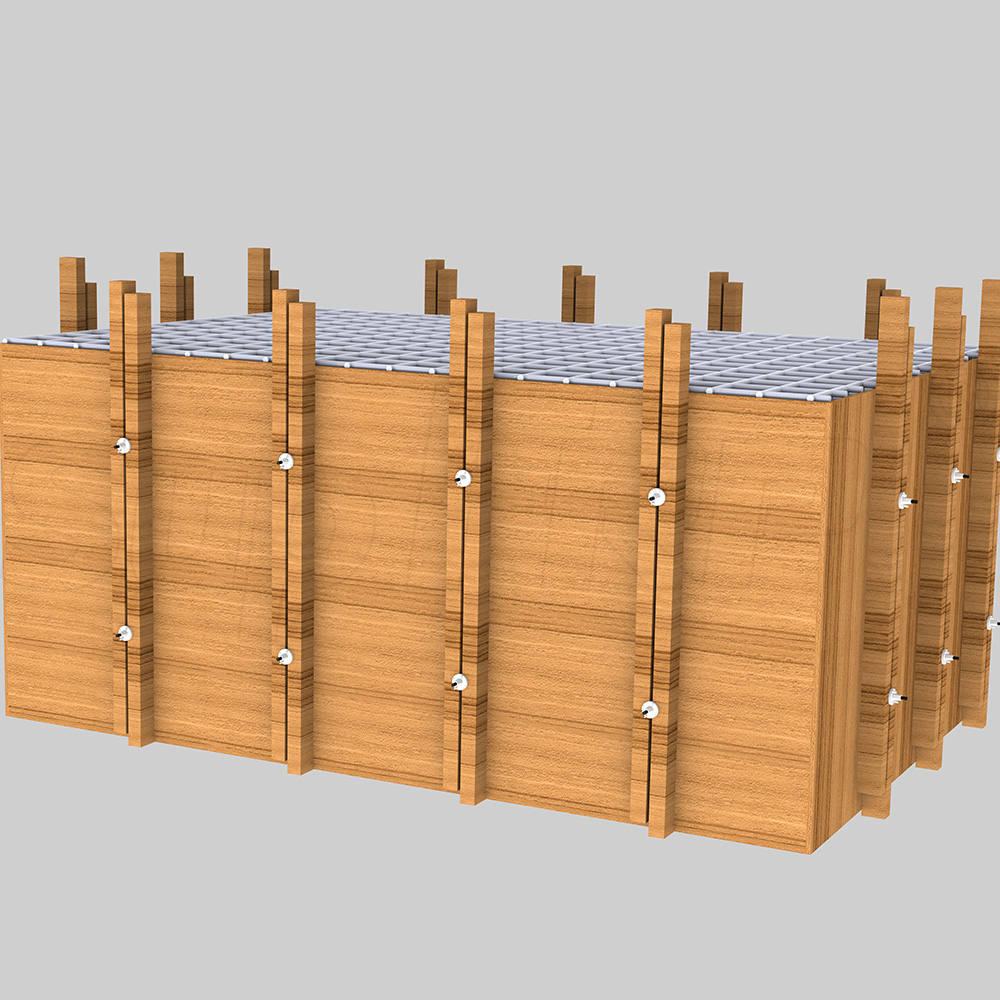
Sichuan, China – In a move set to reshape formwork practices across global construction projects, SupAnchor, a leading geotechnical reinforcement system innovator, has launched its SupFRP® GFRP Tie Rod. The new product is a fiberglass-reinforced polymer (GFRP) alternative to traditional steel tie rods, engineered to remain permanently embedded in concrete structures after casting. This permanent application eliminates the labor-intensive removal process, slashing transportation, storage, and reconditioning costs that have long burdened contractors.
The tie rod is manufactured with a thread profile identical to standard steel rods, ensuring seamless compatibility with conventional formwork accessories. “Our clients kept telling us they needed a tie rod that didn’t have to be extracted, saving time and money, while still delivering the strength they rely on,” said a SupAnchor product engineer. “By leveraging our polymer composite expertise, we’ve created a solution that outperforms steel in corrosion resistance and handling, opening new possibilities for marine, chemical, and civil engineering projects.”
SupAnchor’s new tie rod comes in two primary models – the T15/130 and the T20/250 – covering a broad range of formwork pressures and structural dimensions. The key parameters are summarized in the table below:
| Parameter | T15/130 | T20/250 |
|---|---|---|
| Outside Diameter (mm) *1 | 17 | 22 |
| Nominal Cross-sectional Area (mm²) *2 | 130 | 250 |
| Guaranteed Tensile Load (kN) | 130 | 250 |
| Tensile E-Modulus (GPa) | 45 | 45 |
| Ultimate Strain | 2.0% | 2.0% |
| Weight (kg/m) | 0.37 | 0.71 |
| Available Lengths (m) | 1, 2, 3, 4, 5, 6, 7, 8, 9, 10, 11 | 1, 2, 3, 4, 5, 6, 7, 8, 9, 10, 11 |
*1 Including waved thread structure; *2 Characteristic stress value in core.
The T15/130 delivers a guaranteed tensile load of 130 kilonewtons at a weight of only 0.37 kilograms per meter, making it ideal for lighter-duty formwork in residential and commercial construction. The T20/250, with its 250 kN capacity, handles the heavy demands of civil engineering and infrastructure projects. Both models share a tensile E-modulus of 45 GPa and an ultimate strain of 2.0%, ensuring predictable deformation behavior under load.
Unlike steel, the GFRP material is inherently resistant to corrosion, alkalinity, and chemical attack. This eliminates the need for protective coatings and allows the tie rod to serve as a permanent, low-maintenance component within the concrete. The waved thread structure enhances bond force, while the non-conductive and non-magnetic properties make it suitable for sensitive environments such as MRI rooms, electric substations, and tunnel boring operations.
Traditional steel tie rods must be extracted after concrete cures, often requiring special tools and causing surface damage that must be patched. The labor and equipment costs add up, and the retrieved rods need cleaning, inspection, and storage for reuse—expenses that erode project margins. SupAnchor’s permanent tie rod renders these steps obsolete. Once the formwork is stripped, the exposed ends can be simply cut off, leaving a clean, structurally sound embedment.
“We’re seeing a 30–40% reduction in total formwork handling time on some sites,” noted a project manager who has trialed the product in a tunneling project in Southeast Asia. “And because the rods are so light, our workers can carry several at once, which speeds up assembly.” The weight advantage—less than half that of equivalent steel rods—also slashes shipping costs and on-site crane usage.
Sustainability is another driver. The GFRP tie rod’s permanent application cuts steel consumption and waste. In large marine projects, where corrosion would force premature replacement of steel embedments, the GFRP’s durability can extend the service life of the structure by decades, reducing lifecycle carbon footprints. This aligns with green building certifications and government infrastructure sustainability mandates increasingly enforced in Europe and North America.
While designed primarily for formwork, the SupFRP tie rod’s characteristics open doors to a variety of geotechnical and structural applications. In tunneling and mining, where electromagnetic interference and spark hazards must be managed, non-metallic reinforcement is gaining traction. SupAnchor’s tie rod can serve as a permanent rock bolt or soil nail when combined with grouting techniques, complementing the company’s existing range of self drilling anchor systems and hollow bar anchors.
“This product fits perfectly into our broader geotechnical reinforcement strategy,” said a SupAnchor spokesperson. “We already offer a full suite of drill-and-grout bolt solutions and ground anchor systems, and the GFRP tie rod extends that innovation to formwork. It’s part of our commitment to providing a complete chain of solutions, from temporary support to permanent reinforcement.”
SupAnchor has shipped its GFRP tie rods to projects in the UAE, Australia, and Scandinavia, where they are being used in bridge piers, water treatment plants, and coastal defense structures. The product’s compatibility with standard steel rod accessories means no retooling is needed—contractors simply order the required lengths and use their existing wing nuts and plates.
SupAnchor’s growth over the past decade has been fueled by heavy investment in research and development. The company holds multiple patents for polymer-based and self-drilling anchor technologies, and its manufacturing facilities in China and Vietnam use automated production lines to ensure consistent quality. Certified to ISO 9001, ISO 14001, and OHSAS 18001, SupAnchor’s quality management systems underpin every product that leaves the factory.
The GFRP tie rod is the latest outcome of SupAnchor’s collaboration with construction firms and engineering consultants to address real-world pain points. “Our engineers spend time on job sites understanding how our products perform under extreme conditions,” the company stated. “That hands-on approach led to the development of the tie rod’s waved thread, which improves bond strength without adding weight or cost.”
Looking ahead, SupAnchor plans to introduce additional diameters and customized lengths, as well as integrated monitoring sensors for smart infrastructure. A demonstration video of the tie rod’s application is available on the company’s website.
For more information about SupAnchor’s geotechnical reinforcement systems, including self drilling anchor bolts and hollow bar anchors, visit www.supanchor.com.
SupAnchor's self drilling anchor system played a pivotal role in stabilizing steep slopes during a major highway expansion in the Alps, demonstrating advanced geotechnical reinforcement capabilities.
SupAnchor introduces the SupFRP GFRP Tie Rod, a corrosion-resistant, non-removable formwork solution that cuts costs and improves safety. Learn about its technical advantages and global impact.
SupAnchor's self drilling anchor system plays a critical role in a challenging European infrastructure project, providing efficient ground stabilization and geotechnical reinforcement in difficult soil conditions.
SupAnchor introduces the SupHulk PM series friction rock bolts, offering immediate load-bearing capacity and full-column friction support for mining and tunneling applications. The system features high yield loads and adapts to varied rock conditions.
SupAnchor's self drilling anchor system was deployed in a European alpine tunnel project, solving complex geological challenges with a single-pass drill-and-grout solution, highlighting the strength of hollow bar anchors.